
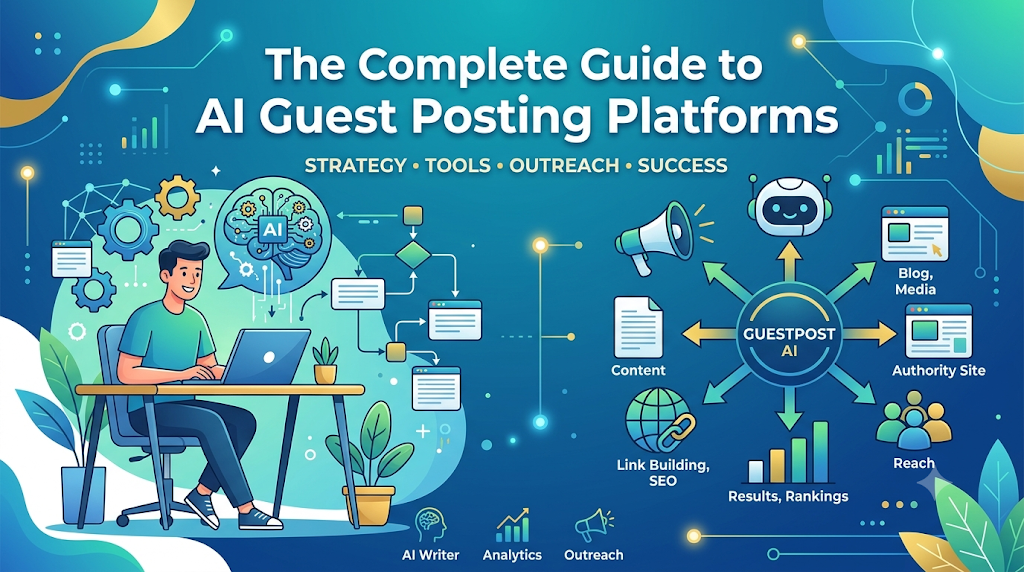
Introduction
Guest posting has been a cornerstone of SEO and content marketing for over a decade. The landscape looks fundamentally different. The days of mass outreach to “write for us” directories and churning out generic content for backlinks are over. Google’s Helpful Content Updates, SpamBrain AI detection, and the rise of AI-powered search engines like ChatGPT Search, Perplexity, and Google AI Overviews have reshaped what works and what doesn’t.
The result? Guest posting has evolved from a volume game into a quality and efficiency game. And at the center of that evolution is the AI guest posting platform — a new category of software that combines content creation, publisher discovery, workflow automation, and campaign management into a single streamlined experience.
This guide explains what AI guest posting platforms are, why businesses still invest in guest blogging, the challenges of traditional workflows, and how AI-powered solutions like GuestPostAI are transforming the industry.
What Is an AI Guest Posting Platform?
An AI guest posting platform is a software solution that uses artificial intelligence to automate and streamline the entire guest posting lifecycle — from content creation to publication.
Unlike traditional guest posting tools that might only handle one part of the process (like outreach or content writing), a comprehensive AI guest post generator and publishing platform manages the full workflow:
- AI-Assisted Writing – Generate article drafts, headlines, outlines, and full posts using AI language models. The best platforms allow you to edit, refine, and customize the output rather than accepting generic, unedited content.
- Publishing Automation – Once content is approved, the platform can schedule and publish articles directly to target websites, eliminating manual copy-pasting and formatting errors.
- Reusable Templates – Save content structures, formatting rules, and SEO preferences as templates for consistent, repeatable publishing across multiple campaigns.
- Website Discovery – Find relevant, high-quality publisher websites based on niche, audience, traffic metrics, and editorial standards.
- Workflow Management – Coordinate content creation, review cycles, approvals, revisions, and publishing across teams, clients, and publishers.
- Campaign Coordination – Manage multiple guest posting campaigns simultaneously from a single dashboard, tracking progress, budgets, and performance metrics.
At its core, an AI guest posting platform acts as a central command center for everything related to guest blogging. It reduces manual effort, eliminates scattered spreadsheets and email threads, and ensures consistency across every placement.
Why Businesses Still Invest in Guest Blogging
Despite predictions of its decline, guest blogging remains a staple in the marketing mix of serious SEO teams. In a recent Authority Hacker survey, 47 to 64.9 percent of SEO professionals reported using guest posting as a primary link-building tactic. And while digital PR has gained ground — with 48.6% of SEOs calling it the most effective link-building tactic in 2025 — guest posting still accounts for 16% of SEOs’ preferred methods. The practice has matured, not disappeared.
Here’s why businesses continue to invest:
- SEO Authority – Editorial backlinks from authoritative domains remain among the top ranking signals Google uses to evaluate trust. A guest post published on a respected industry site delivers a contextual, in-content link that algorithms treat differently from sidebar or footer placements.
- Quality Backlinks – Guest post links from genuine industry publications still pass ranking value. Industry surveys consistently show that domain diversity — the number of unique referring sites linking to you — correlates more strongly with rankings than raw link counts from a small group of domains.
- Referral Traffic – Beyond SEO, guest posts send qualified, targeted traffic from publishers’ audiences directly to your website.
- Brand Awareness – Publishing on platforms your target audience already trusts puts your brand in front of potential customers who might never have discovered you otherwise.
- Trust and Credibility – Appearing on respected third-party sites signals to both Google and human readers that your brand is a legitimate, authoritative player in your space.
- Thought Leadership – Guest posting allows subject matter experts to share insights, showcase expertise, and position themselves — and their companies — as industry leaders.
Guest blogging is one of the few scalable ways to expand link diversity with editorial context attached. That combination — relevance plus authority — is why it remains valuable in 2026 and beyond.
Challenges of Traditional Guest Posting
If guest posting is so valuable, why do so many marketers struggle with it? The answer lies in the fragmented, manual nature of traditional workflows.
- Manual Writing – Every article must be researched, outlined, written, edited, and formatted from scratch. This process is time-consuming and inconsistent across multiple writers and campaigns.
- Publisher Discovery – Finding websites that accept guest posts, are relevant to your niche, and meet quality standards requires hours of research. Many marketers rely on outdated lists or generic “write for us” directories that are often saturated with low-quality sites.
- Outreach – Crafting personalized pitches that get responses is an art form. Generic templates achieve success rates of only 5–8%, while personalized pitches hover around 11.7%. That means dozens or hundreds of emails for every accepted placement.
- Content Revisions – Once a pitch is accepted, the back-and-forth with editors over revisions, formatting, and tone can drag on for days or weeks.
- Image Creation – Sourcing or creating high-quality images, graphics, and featured visuals adds another layer of production work.
- Approvals – For agencies, every piece of content must be reviewed and approved by clients before submission — a process that often involves multiple rounds of feedback.
- Payment Handling – Invoicing, payment processing, and tracking payments across publishers and clients is administrative overhead that distracts from strategy.
- Scheduling – Coordinating publication dates across multiple websites, aligning with product launches or marketing campaigns, and tracking actual publication dates requires meticulous planning.
- Campaign Tracking – Monitoring which placements went live, which links are active, and what results each campaign delivered is often scattered across spreadsheets, emails, and analytics tools.
Traditional guest posting is a series of disconnected tasks. The fragmentation creates inefficiency, delays, quality inconsistency, and missed opportunities.
Introducing GuestPostAI
GuestPostAI is an end-to-end AI guest posting platform designed to solve the fragmentation problem. It combines AI-powered content generation, publisher discovery, payment processing, scheduling, and campaign management into one unified workflow.
Rather than juggling separate tools for writing, outreach, project management, and publishing, GuestPostAI provides a single dashboard where marketers, agencies, and publishers can collaborate seamlessly.
The platform serves both sides of the guest posting equation:
- For buyers (agencies, brands, SEO professionals, startups): Generate SEO-optimized articles, discover relevant publishers, manage submissions, track campaigns, and measure results.
- For publishers (website owners, bloggers, media sites): List your website, receive guest post requests, manage submissions, maintain editorial quality, and generate publishing revenue.
GuestPostAI has positioned itself as a one-stop solution for generating SEO-optimized articles and publishing them directly to blogs with minimal effort — a workflow that marketers and bloggers are increasingly adopting.
What follows is a breakdown of the platform’s core components and how each addresses specific guest posting challenges.
AI Guest Post Generator
Content creation is often the most time-consuming part of guest posting. The AI guest post generator addresses this by using advanced language models to produce article drafts quickly.
Here’s how it works in practice:
You provide a topic, target keywords, desired tone, and any specific angles or points you want covered. The AI generates a complete draft — including headline, introduction, body sections, and conclusion — that you can then review, edit, and refine.
The goal isn’t to publish raw AI output. The best AI guest posting services in 2026 combine automation with human editorial oversight. The AI handles the heavy lifting of structure, research synthesis, and first-draft writing, while human editors ensure accuracy, voice, and strategic alignment.
Key benefits include:
- Speed – Generate a draft in minutes rather than days.
- Consistency – Maintain a consistent tone, structure, and quality across multiple articles and campaigns.
- Flexibility – Edit, expand, or rewrite any section. You remain in control of the final output.
- Scalability – Produce more content without hiring additional writers or overburdening your team.
For agencies managing multiple clients, the ability to generate drafts quickly and then customize them for each brand is a significant productivity multiplier.
SEO Guest Post Generator
Creating content that ranks requires more than just well-written prose. The SEO guest post generator builds search-friendly elements directly into the writing process.
An effective SEO guest post generator considers:
- Keyword Integration – Naturally incorporating primary and secondary keywords without keyword stuffing.
- Content Structure – Using proper heading hierarchy (H1, H2, H3) that helps both readers and search engines understand the content.
- Readability – Maintaining appropriate sentence and paragraph length for human readers.
- Internal and External Linking – Suggesting relevant internal and external links to support context and authority.
- Meta Data – Generating SEO titles, meta descriptions, and URL slugs.
- Topical Relevance – Ensuring the content aligns with the publisher’s existing topics and audience interests.
The goal is content that serves dual purposes: ranking in traditional Google search results and earning citations in AI search engines like Perplexity, ChatGPT Search, and Google AI Overviews.
AI-powered SEO content generation can incorporate elements like FAQs and schema markup to make content “publisher-ready”. This reduces the back-and-forth with editors and increases the likelihood of approval.
Guest Post Marketplace
Finding the right publishers is one of the biggest challenges in guest posting. A guest post marketplace solves this by connecting buyers with vetted publishers in a single, searchable platform.
Modern guest posting marketplaces in 2026 look very different from simple link-buying directories. They provide:
- Publisher Discovery – Browse websites by niche, category, country, language, and audience demographics.
- Pricing Transparency – See upfront costs for guest post placements, with clear breakdowns of what’s included.
- Traffic Visibility – Access estimated traffic data, domain metrics, and audience quality signals.
- Website Filtering – Filter by domain authority, spam indicators, editorial rules, turnaround times, and placement types.
- Campaign Planning – Shortlist publishers, compare options, and plan campaigns strategically.
The strongest marketplaces are moving toward stricter site vetting, clearer sponsorship policies, audience-quality signals, and content standards that protect both buyers and publishers.
For buyers, a marketplace eliminates hours of manual research. For publishers, it provides a controlled way to monetize editorial inventory without accepting every pitch that arrives by email.
Guest Blogging Marketplace
Beyond the transactional exchange of content for links, a guest blogging marketplace facilitates collaboration between multiple stakeholders.
The ecosystem includes:
- Agencies – Manage guest posting campaigns for multiple clients, scale content production, and track results across campaigns.
- Brands – Build authority, generate backlinks, and reach new audiences through targeted placements.
- Publishers – Receive high-quality, relevant content for their audiences while generating revenue.
- Bloggers – Monetize their platforms and build relationships with brands and agencies.
- Website Owners – Grow traffic, authority, and revenue through guest contributions.
In a well-functioning marketplace, AI is embedded across operations — but the better platforms use it to support quality control rather than replace editors. The marketplace becomes a collaborative space where content quality, topical relevance, and editorial integrity are maintained.
Guest Post Publishing Platform
A guest post publishing platform centralizes the entire publishing workflow. Instead of managing content, images, revisions, and approvals across email threads and separate tools, everything lives in one place.
A comprehensive publishing platform provides:
- Centralized Content Management – Store, organize, and access all guest post drafts, final versions, and supporting assets.
- Editorial Workflow – Move content through defined stages: draft, review, revisions, approval, scheduled, published.
- Version History – Track changes, revert to previous versions, and maintain an audit trail of all edits.
- Team Collaboration – Assign roles and permissions for writers, editors, approvers, and clients.
- Publication Tracking – Monitor which articles have been published, which are pending, and which are scheduled.
This centralized approach eliminates the chaos of tracking guest posts across spreadsheets, emails, and disparate tools. It also ensures consistency — every article follows the same workflow, quality standards, and approval process.
Guest Post Management Software
For agencies and marketing teams running multiple campaigns simultaneously, guest post management software is essential.
Beyond basic publishing, management software provides:
- Project Management – Organize campaigns by client, brand, or initiative. Track budgets, deadlines, and deliverables.
- Templates – Create reusable content templates, pitch templates, and workflow templates that ensure consistency across campaigns.
- Reusable Workflows – Define standard operating procedures for content creation, review, approval, and publishing. Apply them to every campaign with one click.
- Team Collaboration – Assign tasks, share feedback, and coordinate across writers, editors, and account managers.
- Version History – Maintain a complete record of every change to every document.
- Campaign Management – View all campaigns in a single dashboard. Monitor progress, identify bottlenecks, and reallocate resources as needed.
For agencies, this transforms guest posting from a chaotic, manual process into a scalable, repeatable service offering.
Automated Guest Post Publishing
Automation is where AI-powered platforms truly differentiate themselves from traditional workflows.
- Automated guest post publishing handles the repetitive, time-consuming tasks that slow down campaigns:
- Workflow Automation – Trigger actions automatically. When a draft is approved, it moves to scheduling. When a post is published, tracking data is updated.
- Approvals – Streamline review cycles with automated notifications and approval routing.
- Scheduling – Set publication dates and times. The platform handles the actual publishing at the specified time.
- Publishing Efficiency – Eliminate manual copy-pasting, formatting adjustments, and technical publishing tasks.
The result is faster time-to-publication, fewer errors, and less administrative overhead. Your team can focus on strategy and quality rather than logistics.
Guest Post Scheduling Tool
Timing matters in content marketing. A guest post scheduling tool ensures your content publishes when it will have the greatest impact.
Scheduling capabilities support:
- Campaign Launches – Coordinate guest posts to publish alongside product launches, announcements, or marketing campaigns.
- Product Announcements – Ensure reviews, announcements, and thought leadership pieces go live at strategic moments.
- Seasonal Marketing – Plan content around holidays, industry events, and seasonal buying cycles.
- Editorial Planning – Build a content calendar that spans multiple publishers and aligns with broader editorial strategy.
- Frequency Management – Avoid publishing too many posts at once (which can appear spammy) or too few (which reduces momentum).
With scheduling, you can plan months in advance, approve content early, and let the platform handle the timing.
Benefits for Publishers
Guest posting platforms aren’t just for buyers. Publishers benefit significantly from participating in a managed marketplace.
- List Websites – Showcase your website to potential guest contributors. Set your own pricing, guidelines, and preferences.
- Receive Requests – Receive qualified guest post requests from brands and agencies that are relevant to your audience.
- Manage Submissions – Review, accept, reject, or request revisions on submissions through a centralized dashboard.
- Maintain Editorial Quality – Set editorial standards and enforce them consistently. Decline content that doesn’t meet your quality bar.
- Generate Publishing Revenue – Monetize your editorial inventory. Turn your website’s authority and audience into a revenue stream.
For publishers, the right platform provides a controlled, efficient way to accept guest content without the chaos of unsolicited email pitches. It also ensures payment is handled professionally and reliably.
Real Business Use Cases
Guest posting platforms serve a wide range of users. Here’s how different businesses benefit:
- SEO Agencies – Scale guest posting for multiple clients. Use templates and reusable workflows to maintain quality while increasing volume. Track results and demonstrate ROI with built-in reporting.
- SaaS Companies – Build authority in competitive niches. Publish thought leadership on industry publications. Earn backlinks that improve search rankings for high-value product and category pages.
- Ecommerce Brands – Generate referral traffic from relevant lifestyle and industry blogs. Build brand awareness among target audiences. Improve domain authority to compete in saturated product categories.
- Bloggers – Monetize existing websites by accepting guest posts. Build relationships with brands and agencies. Grow traffic through quality contributions.
- Startups – Establish credibility quickly. Get in front of target audiences without a massive marketing budget. Build a backlink profile that supports SEO growth.
- Enterprises – Manage large-scale guest posting campaigns across multiple brands, regions, and languages. Maintain brand consistency and quality standards at scale.
- Freelancers – Offer guest posting as a service to clients. Use AI tools to produce content efficiently. Manage multiple campaigns without administrative overwhelm.
Comparison Table
Table 1: Traditional Guest Posting vs. AI-Powered Guest Posting
| Aspect | Traditional Guest Posting | AI-Powered Guest Posting |
|---|---|---|
| Content Creation | Manual writing from scratch; time-consuming and inconsistent | AI-generated drafts in minutes; human-edited for quality |
| Publisher Discovery | Manual research, outdated lists, generic directories | AI-powered search, vetted publishers, relevant matches |
| Outreach | Manual emails, low response rates, high effort | Automated or templated outreach, higher efficiency |
| Workflow | Fragmented across email, spreadsheets, and tools | Centralized, end-to-end platform |
| Quality Control | Inconsistent; depends on individual writers and editors | Standardized templates, automated checks, editorial oversight |
| Scalability | Limited by team size and manual capacity | Highly scalable; AI handles volume, humans handle strategy |
| Campaign Management | Manual tracking across disparate tools | Single dashboard with real-time visibility |
| Time to Publication | Weeks or months | Days or hours |
| Cost | High labor costs; variable quality | Lower labor costs; consistent quality |
Table 2: Feature Comparison — Manual Workflow vs. GuestPostAI
| Feature | Manual Workflow | GuestPostAI |
|---|---|---|
| AI Content Generation | Not available | AI guest post generator with customizable output |
| SEO Optimization | Manual, inconsistent | SEO guest post generator with keyword integration |
| Reusable Templates | None | Save and apply templates for consistent content |
| Publisher Marketplace | Manual research | Curated guest post marketplace with filtering |
| Payment Processing | Manual invoicing | Integrated payment workflow |
| Scheduling | Manual coordination | Guest post scheduling tool |
| Automated Publishing | Manual copy-paste | Automated guest post publishing |
| Campaign Management | Spreadsheets and emails | Centralized dashboard with version history |
| Team Collaboration | Email chains | Built-in collaboration and approvals |
| Publisher Benefits | Unsolicited pitches | Controlled submissions and revenue generation |
| End-to-End Workflow | Fragmented | Unified platform |
Why AI Is Changing Guest Posting
The shift to AI-powered guest posting isn’t a passing trend. It’s a fundamental change driven by market forces and technological capability.
- Productivity – AI handles the repetitive, time-consuming aspects of guest posting — research, drafting, formatting, scheduling — freeing humans for higher-value work like strategy, relationship building, and quality assurance.
- Quality – When used correctly, AI improves quality. It ensures consistency, catches errors, suggests improvements, and maintains editorial standards across hundreds of articles.
- Consistency – Templates, workflows, and automated checks ensure every piece of content meets the same quality bar, regardless of who created it or when.
- Scaling – AI allows teams to produce more content without proportional increases in headcount. This makes guest posting viable for businesses of all sizes.
- Automation – Routine tasks like scheduling, publishing, and tracking are fully automated. Teams spend less time on logistics and more time on outcomes.
AI is now embedded across every stage of the guest posting pipeline — prospect discovery, quality vetting, content creation, outreach personalization, and post-placement performance analysis. The platforms that understand this shift and build for it are the ones that will define the next era of guest posting.
Best Practices
AI-powered guest posting is powerful, but it requires thoughtful implementation. Here are best practices for getting it right:
- Ethical Guest Blogging – Always prioritize genuine value over link acquisition. Create content that educates, informs, or entertains the publisher’s audience. Avoid manipulative tactics, keyword stuffing, or low-quality content.
- AI-Assisted Writing – Use AI as a starting point, not a finished product. Review, edit, and enhance every AI-generated draft. Add your unique expertise, perspective, and voice. The best results come from human-AI collaboration.
- Publisher Relationships – Treat publishers as partners, not link sources. Build genuine relationships. Understand their audience, editorial standards, and content preferences.
- SEO Best Practices – Focus on topical relevance, user intent, and natural language. Write for humans first. Optimize for search without sacrificing readability or quality.
- Quality Assurance – Implement a review process that includes fact-checking, plagiarism checking, readability assessment, and editorial review. Never publish AI content without human oversight.
- Content Review – Have subject matter experts review technical or industry-specific content. Ensure accuracy, depth, and credibility.
- Strategic Planning – Align guest posting with broader marketing goals. Choose publishers that reach your target audience. Measure results and iterate.
- Transparency – Disclose sponsored content appropriately. Follow Google’s guidance on link attributes (nofollow, sponsored, UGC) when required.
Frequently Asked Questions
What is an AI guest posting platform?
An AI guest posting platform is software that uses artificial intelligence to automate and streamline the guest posting process — from content creation and publisher discovery to publishing and campaign management. It centralizes the entire workflow in one dashboard.
Does guest posting still work for SEO in 2026?
Yes, but the rules have changed. Google’s spam updates have made low-quality, volume-based guest posting ineffective or even harmful. However, high-quality guest posts on relevant, authoritative sites still pass ranking value and build brand authority.
Is AI-generated content acceptable for guest posts?
AI-generated content is acceptable when reviewed, edited, and enhanced by humans. The best approach uses AI for first drafts and structure, then applies human expertise for accuracy, voice, and strategic alignment.
How does an AI guest post generator work?
You provide a topic, keywords, and guidelines. The AI generates a complete draft including headline, introduction, body sections, and conclusion. You then review, edit, and refine the output before submission.
What is a guest post marketplace?
A guest post marketplace connects buyers (brands, agencies, SEO professionals) with publishers (website owners, bloggers) who accept guest content. It provides search, filtering, pricing, and transaction capabilities in one platform.
Can publishers earn money through guest posting platforms?
Yes. Publishers can list their websites, set pricing for guest post placements, and receive submissions from qualified buyers. The platform handles payment processing and coordination.
How does automated guest post publishing work?
Once content is approved, the platform schedules and publishes the article to the target website automatically. This eliminates manual copy-pasting, formatting adjustments, and technical publishing tasks.
What’s the difference between a guest post generator and an SEO guest post generator?
A basic guest post generator creates content. An SEO guest post generator also incorporates keyword optimization, content structure, readability, metadata, and other SEO best practices to make the content search-friendly.
Is using AI for guest posting considered ethical?
Yes, when used responsibly. The key is transparency, human oversight, and a commitment to quality. AI should assist, not replace, human judgment and expertise.
How do I choose the right guest post publishing platform?
Look for a platform that combines AI content generation, publisher discovery, workflow management, scheduling, and tracking in one unified system. Consider your specific needs — agency vs. brand, scale, budget, and team size.
Can I manage multiple guest posting campaigns simultaneously?
Yes. Guest post management software allows you to organize campaigns by client, brand, or initiative. Track budgets, deadlines, and deliverables from a single dashboard.
What role does AI play in publisher discovery?
AI helps identify relevant publishers based on niche, audience, traffic quality, and editorial standards. It filters out low-quality sites and suggests matches that are topically aligned with your content.
Conclusion
Guest posting remains one of the most effective ways to build SEO authority, earn quality backlinks, and reach new audiences. But the traditional approach — manual writing, fragmented workflows, and scattered tools — no longer works in today’s competitive, algorithm-driven environment.
The solution is an end-to-end AI guest posting platform that brings everything together: content generation, publisher discovery, workflow management, scheduling, publishing, and campaign tracking. By automating the repetitive tasks and centralizing the entire process, AI-powered platforms make guest posting faster, more consistent, and more scalable than ever before.
GuestPostAI exemplifies this new generation of guest posting software. From its AI guest post generator and SEO guest post generator to its guest post marketplace, scheduling tool, and automated publishing capabilities, the platform provides a complete solution for agencies, brands, startups, publishers, and freelancers alike.
