
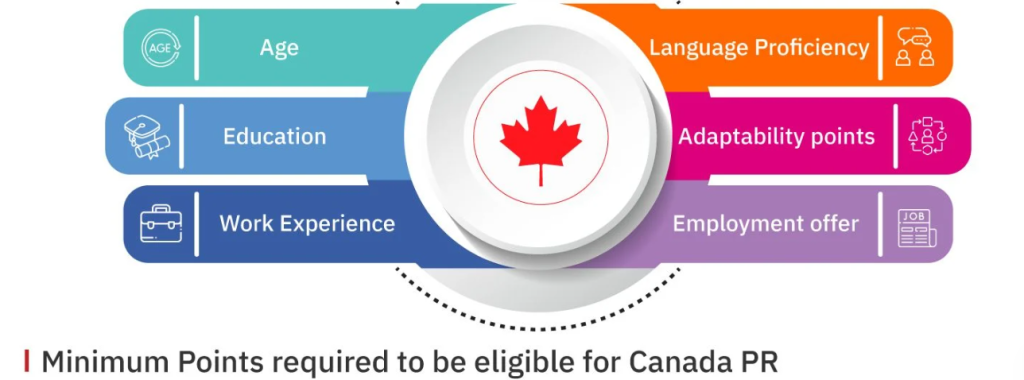
Securing permanent residency in Canada relies on an objective, algorithmic system rather than subjective application reviews. Foreign professionals looking to establish themselves permanently must navigate a comprehensive metric system built to measure long-term economic integration. This structured approach ensures a predictable and transparent path forward.
Before initiating your formal application, understanding how your employment history, educational credentials, and linguistic performance translate into these baseline values is critical. The registration architecture is divided into two distinct components: a preliminary assessment filter and a competitive pool ranking. Confusing these two verification systems can lead to structural delays in your relocation plans.
Using an accurate Canada PR Points Calculator clarifies your ranking, identifying your exact placement without administrative confusion or surprise setbacks.
Understanding the Dual Points System for Canadian Permanent Residency
The processing network relies on a sequential, two-tier evaluation method. Applicants must successfully satisfy the criteria of the first tier before their profile can advance into the competitive selection arena.
Phase 1: The FSWP Eligibility Check
The initial screening mechanism acts as a qualification gateway for overseas professionals. Under the Federal Skilled Worker baseline, candidate profiles are measured against an evaluation framework with a maximum ceiling of a hundred points. Applicants must secure a minimum threshold of 67 points across primary background attributes—including language command, age, employment background, and community adaptability—to advance.
Failing to reach this baseline score prevents you from establishing an active online profile. Conversely, exceeding this benchmark simply validates your entry into the candidate pool; it does not guarantee a relocation invitation.
Phase 2: The Comprehensive Ranking System (CRS) Core Points
Once you pass the initial gatekeeper tier, your profile enters the active talent pool, where it undergoes an alternative evaluation governed by the Comprehensive Ranking System (CRS). This secondary framework calculates individual performance out of a maximum score of twelve hundred points.
This environment measures candidates based on personal human capital traits, accompanying family members, and specialized bonus variables. Official selection invitations (ITAs) are distributed to profiles that clear the shifting benchmark scores set during periodic selection distributions.
| Evaluation Metric | FSWP Eligibility Grid | Express Entry CRS Score |
| Primary Purpose | Confirms baseline eligibility to enter the selection pool. | Ranks candidates competitively to determine invitation distribution. |
| Maximum Score Available | A hundred points | Twelve hundred points |
| Minimum Threshold | 67 points required to qualify. | Fluctuates based on selection round trends and candidate volumes. |
| Core Components Covered | Core language, age, educational credentials, work experience, adaptability. | Core human capital, partner credentials, skill combinations, bonus elements. |
Comprehensive Breakdown of Express Entry CRS Points Criteria
For unattached candidates, personal human capital traits cap out at a maximum of five hundred points. For candidates migrating with a spouse or common-law partner, the primary applicant’s personal human capital ceiling is adjusted to four hundred sixty points, with forty points assigned to their partner’s background credentials.
Core Human Capital Factors (Age, Education, Language)
1. Age Factors (Maximum 110 Points for Single Applicants)
The selection structure provides a distinct advantage to younger applicants who can participate in the local economy for an extended duration. Allotments hit their peak for individuals between the ages of twenty and twenty-nine, after which points drop incrementally with each subsequent birthday.
| Age of Applicant | With Partner / Spouse | Without Partner / Spouse |
| Under 18 | 0 | 0 |
| 18 | 90 | 99 |
| 19 | 95 | 105 |
| 20 to 29 (Peak Points) | 100 | 110 |
| 30 | 95 | 105 |
| 35 | 70 | 77 |
| 40 | 45 | 50 |
| 45 or older | 0 | 0 |
2. Level of Education (Maximum 150 Points)
To claim credit for academic credentials obtained outside of Canada, candidates must secure an Educational Credential Assessment (ECA) via an approved credentialing organization to confirm local academic equivalence.
| Highest Level of Education Achieved | With Partner | Without Partner |
| Secondary school completion | 28 | 30 |
| One-year post-secondary program | 84 | 90 |
| Bachelor’s degree (Three or more year program) | 112 | 120 |
| Two or more credentials (One must be a three-year program or longer) | 119 | 128 |
| Master’s degree or professional degree | 126 | 135 |
| Doctoral university degree (Ph.D.) | 140 | 150 |
Spouse Factors & Skill Transferability
Couples filing a joint application can secure up to forty points through the accompanying partner’s qualifications: up to twenty points for verified language performance, up to twenty points for educational accomplishments, and up to ten points for qualifying professional experience inside Canada.
Additionally, the Skill Transferability section delivers up to a hundred extra points by evaluating cross-factor pairings. For example, pairing an advanced university degree with exceptional language test scores triggers significant secondary points within this section of the grid.
Additional Bonus Points (PNP, Job Offer, Siblings)
A designated block of six hundred points is reserved for specific achievements that drastically improve an applicant’s pool ranking:
- Provincial Nomination (PNP): Six hundred points (The most impactful enhancement).
- Approved Employment Offer in Canada: Fifty or two hundred points (depending on the occupational classification).
- Sibling residing in Canada (Citizen/PR): 15 points.
- French Linguistic Proficiency: Fifty points.
Step-by-Step Guide: How to Calculate Your Canada PR Points
To complete an accurate self-assessment, execute these steps methodically before attempting to build an online profile:
1.Obtain Official Language Scores:Step 1.
Sit for a verified language examination (such as General Training IELTS or CELPIP). Confirmed, authenticated band metrics are required to populate the calculation values accurately.
2.Verify Academic Credentials:Step 2.
Submit academic transcripts to a designated evaluation organization. Foreign degrees require verified equivalence validation before you can claim the associated points.
3.Identify the Occupational Classification:Step 3.
Align your employment history with the official National Occupational Classification (NOC) matrix. Pinpoint your career’s specific Training, Education, Experience, and Responsibilities (TEER) level based on your routine tasks rather than your job title.
4.Consolidate and Calculate Final Scores:Step 4.
Input your verified age, language test scores, educational assessment conclusions, and total years of employment into the calculator to determine your precise pool score.
Actionable Strategies to Boost Your Low CRS Score
If your calculated score sits beneath current selection averages, you can deploy proactive adjustments to upgrade your profile while it resides in the active pool.
Maximizing Language Proficiency (The CLB 9 Target)
Accepting a mediocre language score limits your application’s potential. Reaching the Canadian Language Benchmark (CLB) 9 threshold—requiring individual sub-scores of Listening 8, Reading 7, Writing 7, and Speaking 7 on the IELTS—substantially changes your profile.
Succeeding at this level increases your base language score and interacts with your education and career history fields to unlock up to fifty additional points within the Skill Transferability grid.
The PNP Route: An Instant 600-Point Booster
When core human capital scores are constrained by age or education limitations, regional immigration tracks provide an effective path forward. Provinces consistently search the active pool for professionals with high-demand vocational backgrounds. Attaining a formal provincial nomination adds an instant six-hundred-point boost to your profile, positioning it at the front of the next invitation round.
Leveraging Targeted Category Selection Draws
Immigration authorities utilize specialized category-based selection rounds to address explicit labor shortages within the country. Applicants who possess at least one year of experience in key sectors can secure invitations even with lower baseline scores. Primary focus sectors include:
- Healthcare & Social Assistance Fields (including advanced medical roles and specialized staff).
- STEM Careers (Data Scientists, Software Architects, and Infrastructure Engineers).
- Skilled Trades (Industrial Technicians, Structural Workers, and Specialists).
- Corporate Leadership (Upper-level management roles across various fields).
- Logistics & Transportation (Aviation personnel and supply chain managers).
Frequently Asked Questions (FAQ) Regarding Canada PR Points
Q1. Does meeting the 67-point qualification grid guarantee a permanent resident visa?
Ans: No. Securing 67 points simply satisfies the minimum requirement needed to register an online profile within the selection pool under the Federal Skilled Worker category. Once your registration is complete, your profile is evaluated under the CRS framework. This secondary ranking score dictates whether you receive an invitation to apply.
Q2. Can I successfully immigrate through this system without an active employment offer?
Ans: Yes. A formal job offer is not an absolute requirement. A significant percentage of invited candidates do not have a pre-arranged job with a local employer. If your baseline human capital traits—such as linguistic fluency, age, and academic history—are strong enough to meet general cut-offs or category-specific targets, you can secure an invitation based on your profile’s merits.
Q3. How long does a submitted profile remain active in the selection pool?
Ans: Profiles remain live for a continuous twelve-month period starting from the date of initial submission. If an invitation is not extended within this timeframe, the profile closes automatically. Candidates can then submit a brand-new profile immediately without facing administrative restrictions or penalties.
Q4. Which English language assessments are recognized for points tracking?
Ans: Applicants can complete either the IELTS (General Training) or the CELPIP (General) examination. Academic testing formats are not valid for economic immigration programs. Candidates who speak French can take the TEF Canada or TCF Canada evaluations to unlock significant additional points.
Conclusion: Navigating Your Canada PR Journey with Precision
Calculating your points is not merely a preliminary chore—it is the foundational blueprint of your entire Canadian immigration strategy. In a highly competitive ecosystem where cut-off scores shift and category-based draws target specific economic sectors, operating on guesswork is no longer an option. By knowing exactly where your score stands today, you can shift from a passive applicant waiting in the pool to an active strategist systematically optimizing your profile.
Whether your immediate path forward involves retaking a language test to unlock the CLB 9 bonus points, updating your profile to match a targeted sector draw, or casting a wider net toward provincial nomination (PNP) streams, your success depends on data-driven decisions. Use the Canada PR points calculator to audit your credentials, isolate your profile bottlenecks, and execute the optimizations outlined above. The Canadian immigration landscape rewards preparation—make sure your profile is built to succeed.
