
Introduction
The modern engineering landscape moves fast. Today’s software delivery lifecycles demand that organizations release code rapidly without sacrificing stability, security, or financial efficiency. Yet, many engineering teams remain siloed: developers focus entirely on feature velocity, operations teams scramble to maintain uptime, and security professionals patch vulnerabilities after code has already hit production.
This fragmentation results in fragile pipelines, deployment bottlenecks, and frequent production outages. To bridge these gaps, companies are aggressively hiring cross-functional engineers who understand the complete modern application lifecycle. Navigating this landscape requires validated, production-ready skills.
Without a structured learning path, tech professionals often waste months bouncing between disconnected tutorials, setting up isolated local configurations that work on a laptop but fail instantly inside a high-traffic production cluster. This lack of direction leads to instructional fatigue and stalled career progression, which is why structured upskilling programs and specialized certifications have become vital benchmarks for technical professionals looking to prove their expertise in an increasingly competitive marketplace.
Understanding the Cloud-Native Spectrum
To succeed in a modern platform role, you must understand how several distinct but overlapping operational disciplines intersect:
- Core DevOps: Built around the CALMS framework (Culture, Automation, Lean, Measurement, and Sharing), it focuses on breaking down organizational silos and establishing robust Continuous Integration and Continuous Delivery (CI/CD) pipelines.
- DevSecOps (Development, Security, and Operations): This domain advocates for “shifting left”—embedding automated security audits, compliance scanning, and vulnerability checks directly into the active deployment pipeline rather than treating security as an afterthought.
- Site Reliability Engineering (SRE): Born from managing massive, internet-scale systems, SRE applies software engineering practices to infrastructure problems. It relies on metric-driven approaches, focusing heavily on Service Level Objectives (SLOs) and managing “error budgets” to balance rapid innovation with operational stability.
- Next-Gen Frameworks (AIOps, MLOps, and FinOps): The frontier of enterprise infrastructure, utilizing machine learning to automate operations (AIOps), managing the complex lifecycle of production models (MLOps), and mastering cloud financial optimization (FinOps) to match engineering scale with fiscal responsibility.
Why Certifications Matter in Today’s Industry
The technology sector faces a strange paradox: there is a critical shortage of platform architects, yet thousands of applicants struggle to clear initial resume screenings.
The core issue is a widening practical skill gap. Sitting through conceptual video playlists gives people a false sense of security. Knowing how to run a generic container command locally does not mean someone can handle dynamic routing problems, cluster failures, or security breaches under pressure.
Formalized certification architectures solve this challenge by providing an objective, structured framework for validating expertise. For individual contributors, they offer a clear, step-by-step learning path. For hiring teams, they provide verifiable assurance that a candidate possesses real, production-ready implementation capabilities.
Common Infrastructure Challenges Teams Face
When engineering teams scale organically without adopting structured practices, they almost always run into the same architectural bottlenecks:
- Environmental Inconsistency: Code runs perfectly in a developer’s local workspace but throws unexpected errors when deployed to the test, staging, or production systems.
- Delayed Security Audits: Security teams reject a critical software release at the final hour because compliance scanning wasn’t integrated into the early phases of development.
- Alert Fatigue and Downtime: Operations teams are constantly flooded with unstructured system alerts, resulting in long resolution times, missed SLAs, and costly manual effort (“toil”).
- Cloud Budget Overruns: Automated scaling infrastructure operates without cost guardrails, leading to massive billing shocks at the end of the month.
The Best DevOps Certification Ecosystem Overview
The structured educational tracks available on professional platforms like the Best DevOps Certification Directory address these exact challenges. Rather than focusing on a single cloud vendor’s proprietary systems, this unified ecosystem balances vendor-neutral operational concepts with rigorous, hands-on tool validation.
The learning progression scales smoothly from introductory operational principles to deep, enterprise-grade architecture tracks:
1. Foundational Tier
Establishes core technical and cultural literacy. It focuses on the fundamental lifecycle of continuous software delivery, version control principles, and foundational automation concepts.
2. Core Professional Tier
Tests direct engineering capabilities, emphasizing containerization, configuration management, multi-stage delivery setups, and programmatic infrastructure provisioning.
3. Advanced & Specialty Architect Tier
Allows experienced professionals to align their training with specialized enterprise needs, such as automated pipeline defense, site reliability engineering, AI-driven automation, or multi-cloud platform governance.
Comprehensive Certification Comparison Matrix
The following table provides a complete breakdown of twenty vital certifications within this cloud-native ecosystem, mapping out their categories, levels, and career outcomes:5. Best DevOps Certifications at a Glance
| Certification Name | Best For | Level | Main Skills | Career Scope |
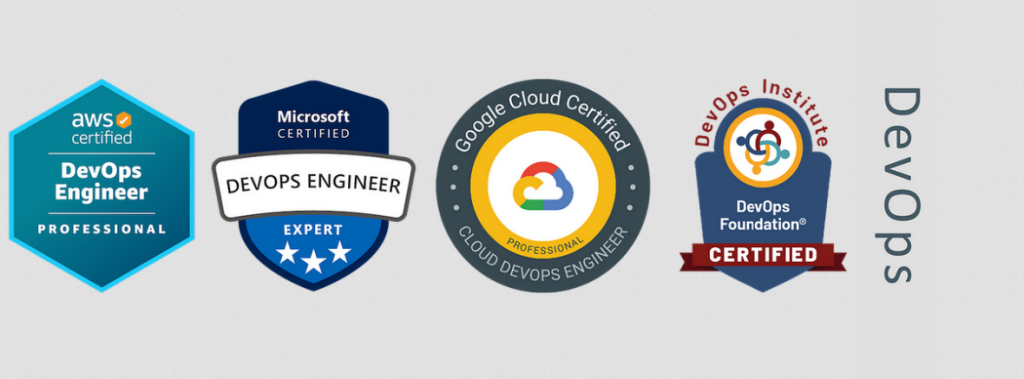
| AWS Certified DevOps Engineer – Professional | Cloud Engineers | Advanced | AWS CI/CD, Automation | Lead DevOps, Cloud Architect |
| Microsoft Certified: DevOps Engineer Expert | Azure Engineers | Advanced | Azure DevOps, IaC | Azure DevOps Engineer |
| Google Cloud Professional Cloud DevOps Engineer | GCP Professionals | Advanced | SRE, CI/CD, Monitoring | GCP DevOps/SRE |
| Certified Kubernetes Administrator (CKA) | DevOps/SysAdmins | Intermediate | K8s Cluster Management | Kubernetes Administrator |
| Certified Kubernetes Application Developer (CKAD) | Developers | Intermediate | K8s Workloads, Pods | Cloud-Native Developer |
| Certified Kubernetes Security Specialist (CKS) | DevSecOps | Advanced | K8s Security, Hardening | DevSecOps Engineer |
| HashiCorp Certified: Terraform Associate | Everyone in DevOps | Beginner | Infrastructure as Code | DevOps Engineer, SRE |
| Docker Certified Associate (DCA) | Beginners | Beginner | Containerization, Swarm | Junior DevOps Engineer |
| AWS Certified SysOps Administrator – Associate | SysAdmins | Intermediate | AWS Operations, Monitoring | Cloud Operator |
| Linux Professional Institute (LPIC-1) | Freshers/SysAdmins | Beginner | Linux Command Line, OS | Systems Administrator |
| Red Hat Certified Engineer (RHCE) | Linux Admins | Advanced | Linux, Ansible Automation | Automation Engineer |
| Certified DevSecOps Professional (CDP) | Security Professionals | Intermediate | CI/CD Security, SAST/DAST | DevSecOps Engineer |
| AWS Certified Developer – Associate | Developers | Intermediate | AWS Services, Deployment | Cloud Developer |
| Certified Jenkins Engineer (CJE) | CI/CD Engineers | Intermediate | Jenkins Pipelines | Build & Release Engineer |
| Prometheus Certified Associate (PCA) | SREs | Beginner | Observability, Metrics | SRE, Observability Engineer |
| FinOps Certified Practitioner | Cloud Managers | Beginner | Cloud Cost Optimization | FinOps Analyst, Manager |
| GitOps Certified Associate (CGOA) | Platform Engineers | Beginner | GitOps, ArgoCD, Flux | Platform Engineer |
| Azure Administrator Associate (AZ-104) | IT Professionals | Intermediate | Azure Infrastructure | Azure Administrator |
| DevOps Institute: DevOps Foundation | Managers/Beginners | Beginner | DevOps Culture, Agile | Scrum Master, IT Manager |
| DevOps Institute: SRE Foundation | IT Operations | Beginner | SRE Principles, SLIs/SLOs | Junior SRE |
Highlighting Important Certifications & Practical Value
DevOps Certified Professional (DCP)
The DCP serves as the baseline working standard for modern delivery teams. It shifts focus away from abstract theory to focus entirely on setting up automated software delivery paths.
- Skills Gained: Multi-branch pipeline assembly, automated deployment strategies, and environment parity.
- Real-World Value: Eradicates the classic “works on my machine” dilemma by ensuring code runs inside consistent, versioned container configurations across all environments.
DevSecOps Certified Professional (DSOCP)
The DSOCP shifts security checking from a manual post-build hurdle into an integrated, automated process within the delivery cycle.
- Skills Gained: Static Application Security Testing (SAST), Dynamic Application Security Testing (DAST), and automated container image registry scanning.
- Real-World Value: Minimizes security friction by catching code flaws and dependency vulnerabilities long before applications reach production systems.
Site Reliability Engineering (SRE) Certified Professional
This track focuses squarely on platform stability, operational scalability, and deep system monitoring.
- Skills Gained: Mapping meaningful alert criteria, building robust telemetry dashboards, and handling automated failover events.
- Real-World Value: Dramatically drops Mean Time to Resolution (MTTR) during complex infrastructure regressions, saving companies valuable uptime revenue.
Real-World Engineering Use Cases
Case A: Streamlining a Microservices Architecture
An enterprise department scales from a legacy monolithic application to dozens of distributed containerized services. Without clear standards, tracking configuration changes becomes unmanageable. An engineer utilizing Master in DevOps Engineering (MDE) design patterns can step in to standardize application properties using declarative infrastructure scripts. Build and deployment steps become entirely automated, allowing individual feature teams to push updates independently without destabilizing neighboring services.
Case B: Maintaining Platform Uptime Through Peak Traffic
An online booking system experiences a sudden, massive spike in traffic during a major promotional event. Thanks to practices learned in the SRE Certified Professional track, the operations team has established automated scaling triggers tied to real-time service metrics using Prometheus and Grafana. The cluster scales up infrastructure nodes automatically to handle the incoming load, ensuring zero drop-off in user experience or transactional processing.
Industry Demand & Career Opportunities
The job market continues to reward technical professionals who hold verified, real-world execution capabilities. Organizations realize that slow, manual release cycles hurt their competitive edge and impact bottom-line revenue.
Hiring managers actively look for comprehensive, vendor-neutral credentials because it means a candidate understands foundational design patterns. A certified engineer isn’t limited to a single web dashboard; they know how to wire up version control, container platforms, security scanners, and tracking tools together into a resilient system, making them highly flexible assets for any growing tech organization. This strong market relevance directly translates to accelerated career paths, stable long-term growth, and clear advantages during compensation evaluations.
Who Should Take These Certifications?
- Beginners & Recent Graduates: Looking to skip generic helpdesk roles and pivot directly into junior cloud or infrastructure positions.
- Software Engineers: Wanting to gain a clear view of how their application code behaves, is tested, and scales within live server environments.
- Systems Administrators: Moving away from manual server configurations toward automated, code-driven infrastructure management.
- Cloud & Security Professionals: Eager to specialize their existing platform skills around automated compliance, telemetry systems, or cluster orchestration.
- Career Switchers: Looking for an objective, structured framework to systematically build competitive tech skills from scratch.
Choosing a Path: Structured Ecosystems vs. Traditional Solo Approaches
Learning engineering methodologies on your own via disconnected blogs or unverified video playlists often leads to significant frustration. Without a curated path, learners frequently run into outdated syntax, broken sample repositories, and lack a mechanism to validate their knowledge.
In contrast, structured professional ecosystems—such as those curated by Best DevOps along with specialized training partners like DevOpsSchool, SREschool, and DevSecOpsSchool—provide a cohesive learning matrix. These programs blend comprehensive instructor-led online training, verified source materials, assignments, and comprehensive interview kits. This holistic approach ensures that professionals build well-rounded architectural skills rather than isolated tool knowledge.
Frequently Asked Questions
1. What is the main difference between DevOps and SRE certifications?
DevOps focus primarily on delivery velocity, pipeline engineering, automated testing, and code delivery mechanics. SRE certifications focus heavily on the runtime environment—maintaining high platform availability, analyzing real-time system metrics, managing error budgets, and treating operational challenges as software engineering problems.
2. Can I start with the DevSecOps track without prior security experience?
Yes. The DevSecOps path is designed for general software developers, systems admins, and cloud engineers. It teaches you how to install and automate security tooling within delivery channels, making it highly accessible without a deep academic background in cybersecurity.
3. How do vendor-neutral certifications compare to vendor-specific cloud credentials?
Vendor-specific paths (like AWS or Azure certs) show you understand how to navigate a particular cloud provider’s product line. Vendor-neutral credentials teach you core architectural patterns and open-source standards (like Git, containers, and orchestration tools) that apply everywhere, allowing you to move across multi-cloud environments seamlessly.
4. How long does it take to prepare for an intermediate certification like the DCP?
If you already work with basic code repos and have a general grasp of cloud environments, you can comfortably prepare for the DevOps Certified Professional (DCP) exam within six to eight weeks of consistent, hands-on practice.
5. Why is container orchestration featured so heavily in modern learning paths?
Containers ensure that applications run completely identically across different developer setups and production data centers. Because modern cloud systems are built out of thousands of moving parts, mastering container runtime and orchestration environments (like Kubernetes) is essential to scaling applications reliably.
6. What kind of career mobility can I expect after completing an advanced master track?
Engineers who finish advanced tiers like the Master in DevOps Engineering (MDE) typically move into high-impact roles like Infrastructure Architect, Lead DevSecOps Engineer, Site Reliability Lead, or Principal Automation Consultant—positions that carry high demand and long-term career growth.
Conclusion
Succeeding in the modern cloud-native arena requires moving past fragmented, tool-specific learning toward an integrated, systemic understanding of the entire software lifecycle. Bouncing between random internet tutorials often leaves engineers with technical blind spots that compromise pipeline security, data integrity, and system uptime. True professional maturity demands a structured approach to technical upskilling.
By following a deliberate learning path—from initial delivery fundamentals up to specialized SRE, container management, and continuous security tracks—you ensure your skills match the precise technical standards required by global enterprises. Investing in systematic training doesn’t just polish a resume; it provides the core competence needed to resolve production challenges, build secure automation, and maintain stable application architectures.
If you are ready to remove the guesswork from your professional upskilling strategy, explore the organized roadmaps, instructor-led tracks, and deep laboratory environments hosted at the Best DevOps Certification Directory. Find the exact certification track that aligns with your immediate career milestones and start building genuine, production-ready engineering confidence today.
