
Introduction
Organizations face massive challenges scaling their data pipelines, ensuring data quality, and maintaining continuous delivery across complex data environments. The CDOE – Certified DataOps Engineer program provides an engineering-centric framework designed to bridge the gap between data engineering, operations, and agile infrastructure management. This comprehensive guide is written specifically for software engineers, systems administrators, cloud infrastructure architects, and data professionals who want to transition from traditional operations into high-growth data infrastructure roles. By focusing on automated validation, continuous integration of data models, and environment predictability, this roadmap helps technical professionals make informed, strategic decisions about their long-term career progression. Understanding these architectural principles allows engineers to shift from reactive troubleshooting to proactive system design, ensuring that data pipelines remain as reliable as production software applications. For those looking to validate these modern capabilities, pursuing formal training through the official CDOE – Certified DataOps Engineer program hosted directly on DataOpsSchool establishes a recognized baseline of technical competency.
What is the CDOE – Certified DataOps Engineer?
The CDOE – Certified DataOps Engineer designation represents a production-focused validation of an engineer’s ability to apply DevOps principles to data workflows. It exists because traditional data engineering frequently suffers from slow deployment cycles, manual testing, and fragile pipelines that break whenever data schemas evolve. Rather than treating data management as a static database administration task, this certification enforces an engineering methodology centered on automation, version control for data structures, and continuous monitoring.
Enterprises require infrastructure that treats data as code, enabling rapid experimentation without risking upstream corruption or downstream analytical errors. The program emphasizes hands-on implementation over abstract theory, forcing candidates to grapple with real-world scenarios like automated regression testing for pipelines, containerized data processing, and orchestrating complex directed acyclic graphs. Ultimately, it validates that an engineer can build predictable, self-healing data environments that align directly with modern cloud-native corporate architectures.
Who Should Pursue CDOE – Certified DataOps Engineer?
This certification program is designed for intermediate to senior technical professionals who sit at the intersection of infrastructure, development, and data analytics. Traditional DevOps engineers and Site Reliability Engineers will find it highly beneficial as enterprise infrastructure increasingly revolves around massive data lakes and real-world streaming pipelines. Data engineers, database administrators, and business intelligence developers who want to break away from manual scripting and adopt automated, scalable workflows will find this training directly applicable to their daily operations.
From a management perspective, technical leaders and engineering managers can leverage this framework to standardize development practices across cross-functional squads. On a global scale, including the rapidly expanding technology hubs across India and North America, there is a severe shortage of professionals who understand both system infrastructure and data lifecycle complexities. Whether you are a cloud specialist looking to diversify your skill set or a data professional aiming to master platform automation, this path provides the necessary technical depth.
Why CDOE – Certified DataOps Engineer is Valuable Beyond Tooling
The modern enterprise technology stack evolves at a frantic pace, with specific open-source tools and proprietary platforms falling in and out of favor every few years. The true value of the CDOE – Certified DataOps Engineer curriculum lies in its focus on foundational methodologies and architectural patterns rather than specific software syntax. It teaches engineers how to think about data state, quality gates, immutable infrastructure, and statistical process control within pipelines regardless of whether they are deploying on AWS, Azure, or on-premises clusters.
By mastering these immutable concepts, professionals protect their careers against tool obsolescence and remain highly adaptable assets to any engineering organization. This strategic focus ensures a remarkable return on time and financial investment, shifting an individual’s professional profile from a basic tool administrator to a highly strategic data platform architect. As companies continue to invest heavily in analytics, the ability to guarantee operational reliability becomes the ultimate differentiator for engineering talent.
CDOE – Certified DataOps Engineer Certification Overview
The professional training program is delivered via the official training portal and hosted on the main academy website. The structural framework of the certification is divided into distinct operational tiers, moving from core conceptual understandings to advanced architectural design principles. Rather than relying on simple multiple-choice memorization tests, the assessment approach relies heavily on practical verification, performance-based scenarios, and simulated engineering environments.
Ownership of the curriculum is maintained by industry practitioners who regularly update the materials to reflect current production challenges across enterprise environments. Candidates are evaluated on their practical ability to diagnose pipeline failures, optimize resource utilization, configure distributed orchestration engines, and implement robust security boundaries around sensitive data repositories. This rigid structure ensures that anyone holding the credential has demonstrated true operational competence under realistic stress conditions.
CDOE – Certified DataOps Engineer Certification Tracks & Levels
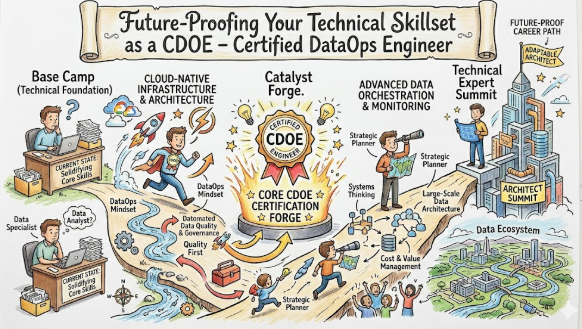
The certification structure is organized into three progressive levels designed to mirror an engineer’s natural career growth from an individual contributor to a strategic technical leader. The Foundation level establishes the baseline vocabulary, version control strategies, and basic pipeline automation mechanics required for entry-level roles. Moving into the Professional level, the focus shifts toward complex orchestration, distributed computing optimization, automated quality testing, and advanced monitoring across multi-stage cloud environments.
Finally, the Advanced level challenges engineers to architect multi-region, highly available data platforms that incorporate automated cost governance, enterprise-grade security compliance, and self-healing recovery systems. These distinct levels allow professionals to target their specific learning objectives based on current project demands while providing a clear, transparent pathway for multi-year career advancement within global organizations.
Complete CDOE – Certified DataOps Engineer Certification Table
| Track | Level | Who it’s for | Prerequisites | Skills Covered | Recommended Order |
| Data Operations | Foundation | Associate Systems Engineers, Data Analysts | Basic Linux, Python, Git fundamentals | Continuous Integration, Basic Pipelines, GitOps | First |
| Platform Infrastructure | Professional | DevOps Engineers, Data Platform Engineers | 2+ years Cloud experience, SQL proficiency | Orchestration, Quality Gates, Testing Automation | Second |
| Enterprise Architecture | Advanced | Principal Engineers, Technical Architects | Extensive Professional track mastery | High Availability, Cost Optimization, Governance | Third |
Detailed Guide for Each CDOE – Certified DataOps Engineer Certification
CDOE – Certified DataOps Engineer – Foundation
What it is
This baseline certification validates an engineer’s comprehension of core data operations principles, focusing on version control, continuous integration mechanics, and reproducible environment configurations.
Who should take it
It is designed for junior software developers, systems administrators, and data analysts who want to establish a standardized foundation in automated data pipeline workflows.
Skills you’ll gain
- Implementation of version control for database schemas and extraction scripts.
- Building basic continuous integration workflows for data transformation validation.
- Configuration of containerized development environments for localized testing.
- Understanding core monitoring metrics for tracking processing delays.
Real-world projects you should be able to do
- Construct an automated GitOps pipeline that validates SQL schema updates before applying them to a staging database.
- Build a reproducible localized development environment using container orchestration tools to isolate data processing dependencies.
Preparation plan
- 7–14 days: Focus entirely on mastering Git branching strategies, basic shell scripting, and understanding the foundational pillars of pipeline orchestration.
- 30 days: Build local projects utilizing open-source automation tools, focusing specifically on error handling and basic notifications upon pipeline failure.
- 60 days: Take mock assessments, review core architectural literature, and build end-to-end local pipelines processing dummy datasets.
Common mistakes
- Underestimating the importance of strict version control practices for data schemas.
- Focusing too much on writing complex transformation logic rather than focusing on the infrastructure pipeline itself.
Best next certification after this
- Same-track option: CDOE Professional Level
- Cross-track option: Cloud Infrastructure Associate
- Leadership option: Technical Team Lead Fundamentals
CDOE – Certified DataOps Engineer – Professional
What it is
This intermediate certification verifies an engineer’s capability to design, build, and maintain production-grade data orchestration systems utilizing complex automated testing and advanced monitoring tools.
Who should take it
Ideal for active DevOps specialists, cloud engineers, and data infrastructure engineers with multiple years of hands-on experience handling multi-stage deployment environments.
Skills you’ll gain
- Orchestration of distributed, multi-stage data pipelines with dynamic dependency mapping.
- Development of automated statistical data quality gates within active runtime pipelines.
- Implementation of centralized logging, tracing, and granular alert mechanics for distributed jobs.
- Configuration of scalable storage and compute resources dynamically based on processing load requirements.
Real-world projects you should be able to do
- Design an enterprise-grade orchestration pipeline that dynamically scales compute nodes, injects data quality assertions, and automatically quarantines corrupt records.
- Build a centralized observability dashboard that tracks pipeline execution duration, resource consumption, and system errors across multiple environments.
Preparation plan
- 7–14 days: Review deep architectural documentation regarding distributed processing engines and complex scheduling algorithms.
- 30 days: Build comprehensive cloud-based architectures that purposefully introduce processing failures to test system recovery mechanisms.
- 60 days: Optimize processing workloads for cost and execution speed, ensuring full alignment with professional testing patterns.
Common mistakes
- Hardcoding environmental variables and access credentials directly within pipeline definitions.
- Neglecting to implement automated rollback features when new pipeline versions introduce processing bugs.
Best next certification after this
- Same-track option: CDOE Advanced Level
- Cross-track option: Site Reliability Engineering Professional
- Leadership option: Enterprise Infrastructure Manager
CDOE – Certified DataOps Engineer – Advanced
What it is
This expert-level certification evaluates a professional’s mastery over global scale enterprise data architecture, multi-region high availability, automated cost governance, and complex data compliance infrastructure.
Who should take it
Aimed strictly at principal engineers, infrastructure architects, and senior technical directors responsible for managing large-scale, multi-tenant enterprise data platforms.
Skills you’ll gain
- Architecture of zero-downtime, multi-region data platform deployments with active failover capabilities.
- Design of automated financial governance frameworks to dynamically restrict processing costs.
- Implementation of strict regulatory compliance infrastructure including programmatic data masking and access auditing.
- Strategic integration of heterogeneous data platforms into a singular, cohesive operational plane.
Real-world projects you should be able to do
- Architect a multi-region data platform capable of automatically shifting processing workloads during infrastructure outages without losing transactional state.
- Create an automated enterprise-wide governance system that programmatically strips personally identifiable information from production datasets before ingestion into analytical environments.
Preparation plan
- 7–14 days: Analyze enterprise case studies detailing catastrophic platform failures, focusing deeply on multi-region network design and disaster recovery.
- 30 days: Design mock enterprise architectures addressing real-world scaling, compliance, and strict financial budget constraints simultaneously.
- 60 days: Defend architectural blueprints against complex failure scenarios, ensuring all elements of governance and automation are completely covered.
Common mistakes
- Prioritizing abstract architectural complexity over long-term system maintainability and operational clarity.
- Failing to align platform security architectures with global legal compliance frameworks during initial planning phases.
Best next certification after this
- Same-track option: Strategic Technical Fellow
- Cross-track option: Principal Enterprise Systems Architect
- Leadership option: Chief Technology Officer Program
Choose Your Learning Path
DevOps Path
Professionals on this route focus on extending traditional continuous integration and continuous deployment paradigms directly into data systems. The primary objective is to eliminate manual handoffs between database developers and infrastructure deployment teams. This path emphasizes infrastructure as code, automated environment provisioning, and deployment validation strategies specific to stateful systems. Engineers learn to treat data transformations with the same structural rigor applied to compiled application binaries.
DevSecOps Path
Security within modern data ecosystems cannot be an afterthought left to periodic manual reviews. This trajectory integrates automated vulnerability scanning, policy enforcement, and encryption mechanisms directly into the continuous delivery pipeline. Engineers working along this vector build mechanisms that dynamically identify sensitive information, rotate access credentials automatically, and audit platform configurations in real time. The ultimate focus is creating a secure perimeter that does not impede velocity.
SRE Path
Site Reliability Engineering focused on data platforms prioritizes system availability, platform latency, and efficient incident response management. This path teaches professionals how to define realistic service level objectives specifically tailored around data freshness and processing completeness. Engineers specialize in building self-healing infrastructure, creating automated throttling mechanisms during peak loads, and conducting blameless post-mortems after unexpected outages.
AIOps Path
This specialization focuses on utilizing algorithmic models and automated machine learning insights to optimize system monitoring and infrastructure management. Engineers learn to build systems that analyze massive volumes of performance telemetry to predict infrastructure failures before they impact production environments. It bridges the gap between classic metric gathering and proactive, machine-driven anomaly detection across enterprise compute clusters.
MLOps Path
Machine learning operations engineers specialize in the unique challenges of versioning, deploying, and monitoring statistical models alongside traditional data pipelines. This path addresses the dual challenge of tracking both software code changes and shifting underlying training datasets over time. Professionals master the creation of continuous retraining pipelines, model registry deployments, and automated drift detection systems to ensure predictions remain accurate in changing markets.
DataOps Path
The core DataOps track concentrates entirely on optimizing the speed, accuracy, and predictability of data delivery across the modern enterprise. This path emphasizes statistical process control, continuous data quality validation, and the orchestrating of disparate distributed computing systems into unified delivery streams. Professionals mastering this path become experts at reducing data engineering cycle times while simultaneously increasing overall organizational trust in analytics.
FinOps Path
As cloud data processing costs escalate, cloud financial management becomes a critical engineering capability. This learning path focuses on building automated visibility into resource consumption, identifying idle compute allocations, and implementing programmatic budget caps across processing clusters. Engineers learn to balance performance requirements against strict financial constraints, ensuring that scale does not lead to unmanageable corporate cloud expenditures.
Role → Recommended CDOE – Certified DataOps Engineer Certifications
| Role | Recommended Certifications |
| DevOps Engineer | CDOE Foundation, CDOE Professional |
| SRE | CDOE Professional, CDOE Advanced |
| Platform Engineer | CDOE Professional, CDOE Advanced |
| Cloud Engineer | CDOE Foundation, CDOE Professional |
| Security Engineer | CDOE Professional, Enterprise Compliance Modules |
| Data Engineer | CDOE Foundation, CDOE Professional |
| FinOps Practitioner | CDOE Professional, Cost Governance Frameworks |
| Engineering Manager | CDOE Foundation, Strategic Architecture Modules |
Next Certifications to Take After CDOE – Certified DataOps Engineer
Same Track Progression
Upon completing the advanced stages of the data engineering operations framework, professionals should pursue deeper specializations within complex distributed storage paradigms and high-performance computing models. This involves exploring niche technical certifications focused on real-time stream processing optimization, large-scale graph databases, and advanced memory-cached architectural layers. This step ensures that an engineer can resolve edge-case scaling bottlenecks occurring at massive petabyte scales.
Cross-Track Expansion
Broadening your operational footprint requires stepping outside of pure data pipelines into adjacent infrastructure disciplines. Highly effective transitions include mastering enterprise-grade container orchestration systems, service mesh implementations, and advanced multi-cloud networking architectures. Gaining these cross-functional capabilities allows a senior engineer to interface seamlessly with corporate platform engineering teams, ensuring data systems align perfectly with general enterprise software delivery strategies.
Leadership & Management Track
For senior individual contributors looking to transition away from daily configuration tasks toward organizational design, the focus must shift to strategic frameworks. Useful secondary paths include formal methodologies centered on enterprise risk management, product management for internal technical platforms, and financial corporate governance. This training helps senior technical professionals translate raw engineering metrics into high-level business value, preparing them for director and executive roles.
Training & Certification Support Providers for CDOE – Certified DataOps Engineer
DevOpsSchool provides comprehensive, live instructor-led training modules specifically tailored toward preparing candidates for enterprise infrastructure challenges through deep hands-on labs and real-world infrastructure scenarios.
Cotocus delivers focused corporate training programs that emphasize containerization strategies, automated deployment methodologies, and the optimization of continuous delivery infrastructure across diverse business sectors.
Scmgalaxy offers an extensive repository of technical tutorials, community forums, and practical step-by-step documentation designed to help individual contributors master configuration management and version control systems.
BestDevOps structures specialized learning bootcamps focused on architectural best practices, helping modern systems engineers transition seamlessly into specialized cloud platform design roles.
devsecopsschool focuses explicitly on the integration of automated security frameworks, vulnerability assessment tooling, and continuous compliance checks within the modern application delivery pipeline.
sreschool provides deeply technical training paths centered on site reliability methodologies, incident management strategies, and the design of highly available, self-healing system frameworks.
aiopsschool explores the cutting-edge intersection of machine learning telemetry analysis and infrastructure management, offering deep insights into automated system monitoring.
dataopsschool serves as the core foundational training platform for data lifecycle automation, offering official preparation resources, practical labs, and comprehensive certification guidance.
finopsschool specializes in educating engineering professionals on cloud financial management, resource utilization optimization, and building automated cost governance layers across infrastructure ecosystems.
Frequently Asked Questions (General)
- What is the primary difference between traditional data engineering and modern DataOps engineering?Traditional data engineering focuses almost exclusively on writing the code required to extract, transform, and load data into repositories manually. Modern operations engineering applies software development best practices—such as automated testing, continuous integration, version control, and infrastructure as code—to ensure those pipelines run reliably at scale without manual intervention.
- How long does it typically take to prepare for the professional level certification exam?For an engineer who already possesses a solid understanding of basic Linux systems, cloud fundamentals, and Python scripting, a period of 30 to 60 days of consistent study and practical lab work is generally sufficient to master the professional examination topics.
- Are there strict architectural prerequisites required before attempting the foundation level course?No formal certifications are mandatory before enrolling in the foundational track, but candidates will experience a significantly flatter learning curve if they possess basic literacy in Git command-line operations, basic SQL queries, and fundamental cloud concepts.
- Does this training program focus on open-source platforms or proprietary enterprise vendor software?The curriculum is intentionally vendor-agnostic, choosing instead to focus heavily on foundational architectural patterns, universal delivery concepts, and open-source orchestration standards that can be universally applied to any cloud ecosystem or proprietary enterprise stack.
- What are the specific career benefits for an established DevOps engineer moving into this domain?As traditional infrastructure provisioning becomes increasingly commoditized, specializing in data operations allows standard infrastructure engineers to capture high-demand roles managing complex, business-critical analytics data systems that require specialized lifecycle management.
- How does the testing mechanism verify that an individual actually possesses practical engineering skills?The examination processes utilize performance-based scenarios within simulated lab environments where candidates must actively troubleshoot broken pipelines, write automation scripts, and correctly configure orchestration files under realistic time constraints.
- Can an engineering manager benefit from this curriculum if they are no longer writing production code daily?Yes, technical leaders gain immense value by understanding the structural patterns, testing strategies, and resource requirements necessary to build highly efficient, reliable cross-functional development teams within their organizations.
- What strategy does the program use to handle the frequent updates occurring within cloud technology stacks?The certification focus remains squarely on unchanging architectural pillars like statistical process control, schema validation strategies, and immutable environment design, ensuring your knowledge outlasts any specific software update cycles.
- Is a background in complex mathematics or data science required to succeed in this career track?No, this is fundamentally an infrastructure and systems engineering discipline focused on pipeline stability, automation, and delivery reliability rather than the creation of deep mathematical algorithms or statistical models.
- How does this certification address the growing need for strict enterprise data privacy compliance?The professional and advanced tracks build practical skills in integrating automated data masking, role-based access controls, and detailed audit logging directly into the data delivery pipeline to satisfy strict international regulations.
- What is the recommended renewal cycle for maintaining active validation status under this framework?To ensure that certified professionals remain entirely up to date with evolving enterprise infrastructure trends, a standard recertification or continuous learning review process is recommended every two years.
- How does mastering these concepts help an organization reduce overall cloud infrastructure spend?By teaching engineers how to build dynamic resource scaling, implement automated cleanup routines for idle test environments, and optimize processing jobs, companies avoid over-provisioning expensive cloud hardware assets.
FAQs on CDOE – Certified DataOps Engineer
- How directly does the CDOE – Certified DataOps Engineer curriculum align with the daily responsibilities of a production site reliability engineer?The alignment is exceptionally tight because modern enterprise applications are entirely dependent on continuous data availability. A site reliability engineer holding this credential shifts from merely monitoring generic virtual machine metrics to actively managing data latency, pipeline processing bottlenecks, and stateful storage replication health. This ensures that the analytical layers supporting customer applications maintain the exact same uptime standards as the front-end web services, directly protecting the enterprise from cascading system failures driven by silent upstream data corruption.
- Does the CDOE – Certified DataOps Engineer program teach practical strategies for handling legacy on-premises database migrations to cloud environments?Yes, the professional and advanced tracks dedicate substantial focus to hybrid infrastructure topologies and zero-downtime data migration patterns. Engineers are trained to design multi-phase migration pipelines that utilize automated schema translation, continuous data replication streams, and real-time validation gates. This methodology allows organizations to systematically move legacy workloads into modern cloud platforms without disrupting active business operations or risking data loss during the structural transition phase.
- What specific automated data testing methodologies are prioritized throughout the practical examination labs?The program prioritizes data quality testing methodologies that can be executed programmatically inside continuous integration loops. This includes null-value checks, data type validations, row-count assertions, distribution variance monitoring, and schema drift detection. Candidates learn to implement these testing layers as mandatory validation gates that automatically quarantine anomalies before they enter clean production warehouses.
- Can individuals operating within highly regulated fields like banking or healthcare safely apply these automation concepts?Absolutely, the advanced certification track focuses heavily on building secure, compliant delivery systems specifically for sensitive industries. It teaches professionals how to implement immutable audit logs, enforce granular encryption at rest and in transit, and automate data lineage tracking. This ensures that every automated change to the pipeline can be fully traced and audited for regulatory compliance reviews.
- How does this certification help software engineering teams reduce their overall deployment cycle times for data intensive features?By eliminating manual environment setups and traditional database administrator approval bottlenecks through automated infrastructure as code and GitOps. The training teaches teams to construct reproducible sandboxes where developers can run automated integration tests against realistic data subsets safely. This drastically cuts down on lead times for releasing new analytical models or database schemas to production.
- What programming languages and configuration scripts are most valuable to master before taking the practical exams?Candidates will achieve the greatest success by possessing intermediate proficiency in Python for writing data manipulation and testing scripts, alongside strong literacy in SQL for data querying. Additionally, a clear understanding of YAML and JSON formatting is essential, as these structures are universally employed to define modern infrastructure configurations and orchestration DAGs.
- How does the curriculum approach the problem of managing and versioning massive historical data sets during pipeline upgrades?The training emphasizes the concept of treating data state as an immutable artifact combined with evolutionary schema migration scripts. Engineers learn to decouple storage layers from compute engines, allowing them to test updated transformation logic on historical snapshots without altering production data. This prevents common upgrade errors that cause catastrophic historical data overwrites.
- Is there a global professional community available to network with after achieving this technical credential?Yes, successful candidates gain access to an exclusive global network of data infrastructure professionals and enterprise architects. This community serves as an excellent resource for sharing emerging production design patterns, discussing novel infrastructure troubleshooting strategies, and discovering high-growth career opportunities across leading international technology organizations.
Final Thoughts: Is CDOE – Certified DataOps Engineer Worth It?
Investing time and professional energy into the CDOE – Certified DataOps Engineer program should be viewed as a strategic upgrade to your technical career foundation. The industry has passed the point where manual infrastructure setups and unmonitored data pipelines are acceptable at an enterprise scale. Organizations require engineers who can build highly automated, completely predictable data systems that mimic the reliability of modern cloud software platforms.
This certification bypasses shallow marketing hype and focuses strictly on validating the concrete engineering capabilities required to build and secure those platforms. If your goal is to transition away from routine scripting into a high-leverage architectural role that commands respect across modern engineering organizations, securing this credential provides a clear, recognized pathway to that objective. Focus on mastering the underlying operational patterns, and your technical expertise will remain highly valued across the industry for years to come.
