
Introduction
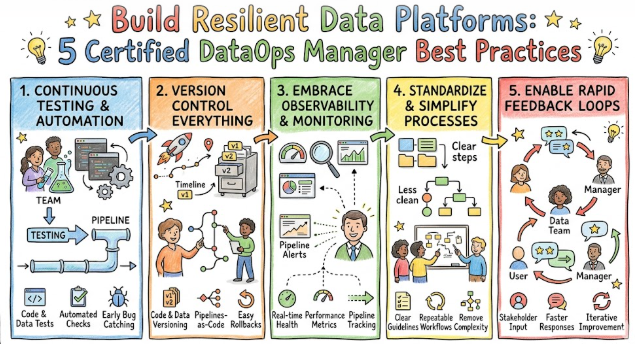
The modern data landscape is shifting rapidly, requiring engineering teams to move away from isolated data pipelines toward highly automated, reliable, and scalable infrastructure. The Certified DataOps Manager program addresses this shift by bridging the gap between traditional data engineering, continuous integration pipelines, and robust platform mechanics. This comprehensive guide is designed for software engineers, site reliability teams, cloud architects, and technology leaders who want to build predictable data workflows and accelerate their career growth. By exploring this structured roadmap, professionals can cut through market noise, evaluate their current technical capabilities, and make highly informed decisions about their next career steps. If you want to streamline data delivery, you can check the certifications available through the official DataOpsSchool platform to begin your structured journey.
What is the CDOM – Certified DataOps Manager?
The Certified DataOps Manager designation represents a rigorous, production-focused standard designed to instill discipline in data lifecycle management. Rather than focusing on abstract theories or isolated tool tutorials, this program emphasizes the practical application of continuous integration, automated testing, and observable infrastructure within data environments. It exists because modern enterprises struggle with fragile data pipelines, unpredictable data quality, and slow deployment cycles that hinder business decisions. By aligning data workflows with proven DevOps principles, this certification ensures that technical professionals can design systems that handle massive data volumes while maintaining strict compliance, high availability, and structural integrity.
Who Should Pursue CDOM – Certified DataOps Manager?
This certification program is built specifically for data engineers, platform architects, site reliability engineers, and cloud database administrators who are responsible for maintaining complex data ecosystems. It is equally valuable for engineering managers, tech leads, and security professionals who need to oversee data compliance, governance, and rapid deployment cycles across cross-functional teams. Experienced engineers will find it provides a structured framework to validate their architectural expertise, while mid-career professionals can use it to transition into high-demand data infrastructure roles. Globally and across the rapidly expanding digital landscape in India, enterprise organizations are actively seeking professionals who can bridge the gap between software development operational standards and data analytics management.
Why CDOM – Certified DataOps Manager is Valuable Beyond Measure
The value of this certification lies in its deep focus on architectural principles and operational methodologies rather than transient software utilities. Tools and frameworks change frequently, but the core patterns of automation, orchestration, feedback loops, and data quality assurance remain constant over time. Holding this credential demonstrates that a technical professional understands how to reduce operational overhead, eliminate manual interventions, and minimize the time it takes to move data from ingestion to consumption safely. Enterprises are heavily adopting these practices to prevent costly data downtime, creating an immediate and sustained return on investment for individuals who master these operational strategies.
CDOM – Certified DataOps Manager Certification Overview
The structured educational program is delivered entirely through the official training channels and hosted on the primary organization platform. The certification architecture avoids simple multiple-choice memorization, prioritizing practical assessments, scenario-based evaluations, and real-world implementation challenges instead. Candidates must demonstrate a granular understanding of environment provisioning, orchestrating complex workflows, monitoring pipeline health, and enforcing security policies across the data lifecycle. The ownership of the curriculum is driven by industry practitioners, ensuring that the course components reflect the exact operational hurdles encountered in enterprise production environments today.
CDOM – Certified DataOps Manager Certification Tracks & Levels
The curriculum is divided into three distinct phases to accommodate professionals at varying stages of their career progression. The foundational level establishes core competencies in data pipeline mechanics, basic automation, and version control principles for data artifacts. The professional tier elevates this knowledge by introducing advanced orchestration, comprehensive test automation, monitoring frameworks, and infrastructure as code practices. Finally, the advanced level is tailored for architects and technical managers, focusing on enterprise governance, multi-cloud data strategies, organizational scaling, and cost optimization methodologies across the engineering department.
Complete CDOM – Certified DataOps Manager Certification Table
| Track | Level | Who it’s for | Prerequisites | Skills Covered | Recommended Order |
| Data Operations | Foundation | Associate Engineers | Basic Linux & SQL | Git, Basic CI/CD, Data Pipes | First |
| Pipeline Architecture | Professional | Senior Data/DevOps | Foundation Level | Orchestration, IaC, Testing | Second |
| Enterprise Strategy | Advanced | Tech Leads / Managers | Professional Level | Governance, Security, Scale | Third |
Detailed Guide for Each CDOM – Certified DataOps Manager Certification
CDOM – Certified DataOps Manager – Foundation Level
What it is
This entry-level certification validates a professional’s understanding of foundational data operations, version control fundamentals, and basic automated pipeline construction.
Who should take it
Systems administrators, junior cloud engineers, and associate data analysts looking to establish a disciplined, automation-first approach to data workflows.
Skills you’ll gain
- Version control operations for data schemas and pipeline configurations.
- Basic construction and execution of continuous integration workflows.
- Fundamental monitoring and alerting setups for storage and ingestion layers.
Real-world projects you should be able to do
- Build an automated ingestion pipeline that triggers on code check-ins.
- Implement structural validation tests on raw incoming data files automatically.
Preparation plan
- 7-14 Days: Focus on fundamental Git workflows, command-line operations, and basic SQL schema migrations.
- 30 Days: Study standard continuous integration runner configurations and practice setting up automated test steps.
- 60 Days: Build end-to-end sandbox pipelines that automatically move sample data from source storage to target databases.
Common mistakes
- Ignoring version control best practices and making changes directly in production environments.
- Skipping structural data validations, leading to downstream pipeline failures during test executions.
Best next certification after this
- Same-track option: CDOM Professional Level
- Cross-track option: Cloud Infrastructure Associate
- Leadership option: Technical Team Lead Fundamentals
CDOM – Certified DataOps Manager – Professional Level
What it is
This mid-tier certification certifies an engineer’s capability to orchestrate complex, multi-stage data workflows, manage infrastructure as code, and implement comprehensive test suites.
Who should take it
Senior DevOps engineers, platform practitioners, and experienced data engineers responsible for the reliability and scalability of enterprise data pipelines.
Skills you’ll gain
- Advanced workflow orchestration and dependency management across distributed compute systems.
- Declarative infrastructure provisioning for databases, data warehouses, and processing clusters.
- Comprehensive performance monitoring, anomaly detection, and automated recovery strategies.
Real-world projects you should be able to do
- Provision a fully automated, scalable data processing cluster using infrastructure as code templates.
- Configure an orchestration engine that handles parallel data transformations with built-in retry logic.
Preparation plan
- 7-14 Days: Master declarative infrastructure syntax and state management configurations.
- 30 Days: Deep dive into distributed workflow orchestration engines and dependency graph designs.
- 60 Days: Implement real-time monitoring, log aggregation, and metric alerting across an entire staging environment.
Common mistakes
- Hardcoding environmental variables and credentials within code repositories instead of utilizing secrets managers.
- Failing to account for transient network failures, resulting in fragile pipelines without retry mechanisms.
Best next certification after this
- Same-track option: CDOM Advanced Level
- Cross-track option: Site Reliability Engineering Professional
- Leadership option: Data Operations Director
CDOM – Certified DataOps Manager – Advanced Level
What it is
This strategic credential validates a leader’s ability to design enterprise-wide data governance models, enforce global security standards, and optimize multi-cloud infrastructure expenditures.
Who should take it
Principal architects, engineering directors, and technical managers overseeing large-scale infrastructure and distributed engineering squads.
Skills you’ll gain
- Enterprise data governance design, lineage tracking, and automated compliance auditing.
- Cost allocation models, resource optimization patterns, and multi-region architecture scaling.
- Cross-functional leadership strategies for scaling technical practices across siloed business divisions.
Real-world projects you should be able to do
- Design a comprehensive data lineage and access control system that complies with global privacy mandates.
- Implement an automated cost optimization framework that scales down processing clusters based on utilization metrics.
Preparation plan
- 7-14 Days: Review global regulatory frameworks, compliance audit requirements, and access control models.
- 30 Days: Analyze enterprise architecture patterns, data lineage structures, and cross-region replication strategies.
- 60 Days: Develop complete organizational transformation blueprints focusing on financial guardrails and architectural standards.
Common mistakes
- Focusing exclusively on tooling choices rather than establishing sustainable organizational cultures and workflows.
- Overlooking long-term operational costs and architectural complexity during the initial system design phase.
Best next certification after this
- Same-track option: Enterprise Infrastructure Fellow
- Cross-track option: Strategic Cloud FinOps Leader
- Leadership option: Chief Technology Officer Certification
Choose Your Learning Path
DevOps Path
This path guides professionals focused on building the underlying deployment engines and automated environments that host data platforms. Engineers learn how to treat data configurations exactly like software code, utilizing continuous delivery methods to ship pipeline updates safely. The focus centers on reducing deployment cycle times, managing environmental drift, and ensuring that development teams have self-service access to production-like infrastructure without compromising security controls.
DevSecOps Path
Security must be woven directly into the fabric of data operations rather than treated as an afterthought. This path instructs specialists on how to integrate automated security scanning, policy enforcement, and encryption mechanisms directly into continuous delivery channels. Professionals focus on preventing data leaks, managing secrets securely, validating container vulnerabilities, and ensuring compliance audits happen seamlessly during every single deployment cycle.
SRE Path
Reliability engineers prioritize the uptime, observability, and performance characteristics of distributed data systems. This learning track teaches professionals how to define service level objectives, configure comprehensive monitoring, build alerting configurations, and design self-healing architectures. By applying software engineering solutions to operational problems, engineers learn how to minimize data downtime and handle unexpected traffic spikes efficiently.
AIOps Path
Automating infrastructure operations using predictive intelligence is key to handling massive, modern scales. This curriculum covers how to ingest large streams of system logs, performance metrics, and operational events to forecast system failures before they occur. Engineers learn to train and deploy anomaly detection models that automatically trigger remediation workflows, reducing manual alerting fatigue significantly.
MLOps Path
Deploying machine learning models require specialized operational lifecycles distinct from traditional software artifacts. This path teaches engineers how to manage model registries, automate training pipelines, version heavy datasets, and monitor production inference engines for performance drift. The core objective is ensuring that analytical models move from experimental sandboxes to production scale reliably and consistently.
DataOps Path
This specialized framework concentrates directly on the orchestration, validation, and delivery speed of data assets within enterprise systems. Professionals learn to apply agile development principles to data engineering, implementing automated testing for data quality, format consistency, and schema mutations. The goal is to maximize statistical predictability while reducing the engineering cycle times required to deliver new data products.
FinOps Path
Managing cloud infrastructure expenditures requires clear visibility, financial accountability, and automated governance. This track focuses on analyzing infrastructure usage patterns, identifying wasted compute allocations, and implementing automated scheduling to turn off underutilized resources. Engineers and managers gain the exact skills required to balance high-performance data processing demands with strict corporate budget constraints.
Role → Recommended CDOM – Certified DataOps Manager Certifications
| Role | Recommended Certifications |
| DevOps Engineer | CDOM Foundation + CDOM Professional |
| SRE | CDOM Professional + Infrastructure Observability |
| Platform Engineer | CDOM Professional + Advanced Systems Architecture |
| Cloud Engineer | CDOM Foundation + Cloud Architecture Professional |
| Security Engineer | CDOM Professional + Enterprise Data Governance |
| Data Engineer | CDOM Foundation + CDOM Professional |
| FinOps Practitioner | CDOM Professional + Cloud Financial Management |
| Engineering Manager | CDOM Advanced Level + Strategic Leadership |
Next Certifications to Take After CDOM – Certified DataOps Manager
Same Track Progression
After mastering the core fundamentals and professional practices, engineers should target deep technical specializations that focus on highly distributed database systems, specialized ingestion engines, and advanced streaming architectures. This path involves tackling complex synchronization challenges, ultra-low latency processing, and large-scale replication across multiple cloud hosting platforms.
Cross-Track Expansion
Broadening your technical footprint involves pursuing infrastructure as code specializations, advanced container orchestration credentials, or site reliability engineering paths. Expanding your knowledge base into adjacent disciplines ensures you can manage the entire modern platform stack, understanding exactly how network topology, container environments, and data layers interact under heavy enterprise workloads.
Leadership & Management Track
For professionals transitioning away from daily keyboard configurations toward organizational strategy, moving into technology management certifications is the logical next step. This focus areas centers on budget optimization, building high-performing engineering cultures, designing organizational structures, and aligning engineering outcomes directly with overarching business growth strategies.
Training & Certification Support Providers for CDOM – Certified DataOps Manager
DevOpsSchool provides extensive, instructor-led training regimens and deep dive lab environments focused heavily on automated deployment strategies, platform engineering fundamentals, and continuous integration tooling implementations for modern tech organizations.
Cotocus delivers specialized bootcamps and customized enterprise training paths that bridge the gap between application delivery pipelines and complex underlying cloud infrastructure architectures.
Scmgalaxy serves as a comprehensive knowledge hub and community resource, offering detailed tutorials, implementation blueprints, and technical guides for configuration management specialists worldwide.
BestDevOps focuses on delivering highly practical, production-oriented training courses designed to help engineers master continuous deployment mechanisms and observable architecture patterns.
devsecopsschool champions the critical integration of security principles into standard software development pipelines, offering structured courses on automated vulnerability scanning and policy governance.
sreschool provides targeted educational programs that teach engineers how to manage large-scale systems reliability, implement error budgets, and build resilient distributed architectures.
aiopsschool explores the cutting-edge intersection of machine learning operations and infrastructure automation, guiding professionals through predictive analytics implementations for system health.
dataopsschool stands as a premier training institution focused exclusively on continuous data delivery, automated pipeline testing workflows, and enterprise data management practices.
finopsschool delivers specialized financial engineering programs designed to help cloud professionals analyze architecture costs, minimize waste, and implement strict cloud budget guardrails.
Frequently Asked Questions (General)
- What are the primary prerequisites for enrolling in the foundational program?Candidates should possess a working understanding of basic Linux command-line operations, version control fundamentals using Git, and elementary relational database concepts using standard SQL syntax.
- How long does it typically take to complete the professional level certification?Most working professionals dedicate between four to eight weeks, averaging approximately five to ten hours of structured study and hands-on laboratory practice per week to master the concepts thoroughly.
- Are the examinations primarily theoretical or do they include practical evaluations?The evaluation matrix focuses heavily on scenario-based challenges and hands-on laboratory simulations where candidates must fix broken pipelines or provision specific automated environments correctly.
- Can I skip the foundational level if I already have extensive DevOps experience?While experienced engineers possess many transferable skills, starting with the foundation or taking a diagnostic assessment ensures there are no critical gaps regarding data-specific testing paradigms and schema migration automation.
- How long does the certification remain valid after passing the examination?The credential carries a standard validity period of three years, after which professionals can recertify by completing advanced elective tracks or passing an updated methodology evaluation.
- What career opportunities open up after completing the advanced management track?Graduates frequently secure high-level roles such as Principal Data Architect, Platform Engineering Director, Infrastructure Lead, or Head of Data Operations within enterprise technology organizations.
- How does this program differ from traditional data engineering certifications?Traditional certifications focus primarily on specific database engines or analytical querying techniques, whereas this curriculum focuses on the continuous integration, testing, automation, and reliability of the data delivery system itself.
- Is financial aid or group corporate pricing available for these educational tracks?Many affiliated training partners offer structured corporate discount packages for engineering teams looking to upskill multiple members simultaneously during enterprise transformation initiatives.
- What specific automation tools are utilized during the practical lab sessions?The labs utilize industry-standard, open-source orchestration utilities, continuous integration runners, infrastructure configuration tools, and comprehensive container management environments to teach platform-agnostic skills.
- How frequently is the training curriculum updated to reflect industry shifts?The governing council reviews and updates the course components annually to ensure all modules reflect current production challenges, security compliance shifts, and architectural best practices.
- Are the training sessions delivered live or through self-paced learning modules?Candidates can choose between flexible, self-paced digital learning paths or interactive, live instructor-led bootcamps depending on their individual schedule availability and preferred learning methodology.
- What kind of documentation or proof of certification do successful candidates receive?Graduates receive secure digital badges and verifiable cryptographic credentials that can be easily displayed on professional networking profiles and shared with prospective enterprise employers.
FAQs on CDOM – Certified DataOps Manager
- How directly does the CDOM designation impact average salary scales for engineers?Holding this verified credential distinguishes professionals from general developers, often resulting in significant compensation increases because enterprise organizations face a critical shortage of specialists who understand how to build reliable, highly automated data platforms at scale.
- Does the curriculum cover strict data privacy frameworks like GDPR and HIPAA compliance?Yes, enterprise data governance, compliance auditing automation, and strict access controls are deeply integrated into both the professional and advanced tracks, ensuring engineers know how to safeguard sensitive personal records within automated delivery pipelines.
- Can software developers with zero database experience successfully navigate this training program?While helpful, deep database administration experience is not mandatory; developers can leverage their existing software engineering discipline, continuous integration knowledge, and code testing familiarity to quickly master data delivery automation.
- What specific testing methodologies are taught within the pipeline architecture modules?The course material covers automated schema validation, null value detection, row count verifications, data volume anomaly alerting, and structural integrity testing to ensure bad source data never corrupts downstream analytical systems.
- How does the training address environmental drift between staging and production databases?Engineers learn to utilize declarative infrastructure as code templates and automated migration scripts, treating database schemas exactly like application code to ensure all deployment environments remain identical.
- Is the CDOM program applicable for organizations utilizing legacy on-premises data warehouses?Absolutely, because the core architectural principles of automation, orchestration, monitoring, and validation remain completely identical whether your data infrastructure is hosted in a legacy local datacenter or a modern multi-cloud environment.
- What orchestration patterns are emphasized for handling complex, interdependent data workflows?The modules focus on directed acyclic graph construction, conditional execution loops, automated retry mechanisms for transient network drops, and parallel processing strategies to optimize compute efficiency and data throughput times.
- How does this certification help engineering managers reduce overall data downtime?By teaching managers how to establish clear operational metrics, construct comprehensive monitoring dashboards, and foster cross-functional collaboration, teams can detect pipeline failures instantly and remediate them before downstream business operations are affected.
Final Thoughts: Is CDOM – Certified DataOps Manager Worth It?
Investing your valuable time and educational resources into this program depends entirely on your long-term career goals. If you are looking for a shallow overview of specific product features or quick marketing tutorials, this intensive curriculum will likely prove overwhelming. However, if your goal is to build deep, structural engineering competencies, master predictable deployment workflows, and lead enterprise infrastructure transformations, the program provides clear execution blueprints. The modern tech landscape heavily rewards specialists who can bring discipline to chaotic data environments. By treating data operations with the same rigor as mission-critical software engineering, you place yourself at the forefront of the next major evolution in enterprise platform architecture.
