
Introduction
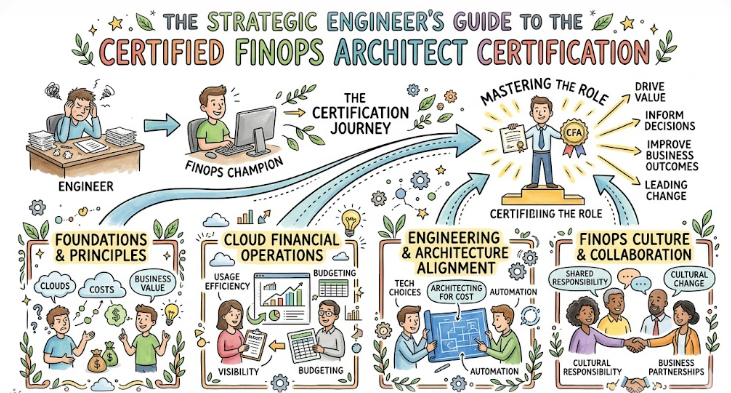
Cloud computing has revolutionized how enterprises build and scale software, but it has also introduced unprecedented financial complexity. The Certified FinOps Architect program is a specialized training and certification framework designed to bridge the gap between cloud engineering, finance, and business strategy. This guide is written for software engineers, DevOps professionals, Site Reliability Engineers (SREs), and technical leaders who want to move beyond basic cloud management and master the art of cloud financial optimization. As organizations face rising infrastructure bills and inefficient resource utilization, professionals who understand both the architecture and the economics of the cloud are in high demand across platform engineering and enterprise operations. By reading this comprehensive guide, technology professionals and engineering managers will gain the clarity needed to make informed career decisions, understand the rigorous requirements of the certification, and chart a structured learning path that aligns with modern cloud-native practices. This curriculum, hosted by FinOpsSchool, ensures that technical teams can build highly scalable systems without compromising financial efficiency.
What is the Certified FinOps Architect?
The Certified FinOps Architect designation represents the highest level of expertise in cloud financial management and architectural optimization. It is an industry-aligned certification program that exists to validate an engineer’s or architect’s ability to design, implement, and maintain cost-effective cloud infrastructure without sacrificing performance, security, or reliability. Unlike introductory courses that focus merely on financial theory, basic budgeting, or reading cloud invoices, this program emphasizes real-world, production-focused learning. It forces candidates to deep-dive into complex cloud environments, architectural trade-offs, and automated governance models. The certification aligns directly with modern engineering workflows, infrastructure-as-code pipelines, and enterprise practices, ensuring that financial accountability is embedded directly into the continuous integration and continuous deployment software lifecycle.
Who Should Pursue Certified FinOps Architect?
This certification is specifically engineered for professionals who handle large-scale cloud deployments and are responsible for infrastructure spending and design. Systems engineers, DevOps practitioners, SREs, and cloud architects who regularly design distributed systems will find immense value in learning how their technical choices impact corporate margins. Security, data, and machine learning engineers will also benefit greatly, as data pipelines and AI workloads represent some of the fastest-growing and least predictable cloud expenses today. The program caters to both experienced engineers looking to move into principal roles and engineering managers or technical leaders who need to establish financial governance frameworks across entire business units. Globally, and specifically within fast-growing technology hubs like India, enterprises are aggressively hiring professionals who can balance rapid innovation with strict cost optimization, making this a highly relevant career milestone.
Why Certified FinOps Architect is Valuable and Beyond
In the current enterprise landscape, building a system that simply works is no longer sufficient; cloud architectures must be economically viable over the long term. The demand for certified financial architects continues to outpace the supply of traditional cloud engineers because organizations have realized that unoptimized cloud spending directly degrades profitability. Obtaining the Certified FinOps Architect designation ensures long-term career longevity and protects technical professionals against shifting tool ecosystems, as it teaches foundational economic principles and cultural frameworks that apply universally across AWS, Azure, and Google Cloud. This certification helps professionals stay highly relevant because it shifts their value proposition from basic infrastructure provisioning to strategic business enablement. The return on time and career investment is substantial, frequently resulting in rapid promotions, leadership opportunities, and the ability to command premium compensation in a competitive global job market.
Certified FinOps Architect Certification Overview
The comprehensive education and assessment program is delivered via the Certified FinOps Architect track and hosted securely on the FinOpsSchool platform. The certification process utilizes a performance-based assessment approach that blends rigorous theoretical evaluations with practical, scenario-based architecture challenges to test actual problem-solving capabilities. Ownership of the certification curriculum is maintained by a panel of industry veterans, ensuring the material remains constantly updated with changing cloud provider pricing models and enterprise architectural patterns. Structurally, the program requires candidates to demonstrate proficiency across multiple core domains, including data ingestion, allocation, forecasting, optimization strategies, and organizational alignment. Rather than relying on simple memorization, the structure forces candidates to actively demonstrate how they would remediate real-world billing anomalies and design cost-effective multi-tenant architectures.
Certified FinOps Architect Certification Tracks & Levels
The certification structure is divided into three distinct tiers: foundation, professional, and advanced levels, allowing candidates to enter the ecosystem at a point that matches their current experience. The foundational tier focuses on establishing a shared cultural language, basic cloud billing concepts, and primary cost allocation methodologies across the organization. The professional tier shifts focus toward active optimization, advanced tagging strategies, forecasting models, and the technical implementation of cost-saving mechanisms like commitment discounts and spot instances. The advanced level, which culminates in the architect designation, requires deep technical mastery of automated policy enforcement, unit economics, and complex multi-cloud architectural patterns. These levels are designed to align directly with traditional corporate career progression, guiding a practitioner from an execution-focused engineer to a strategic enterprise architect.
Complete Certified FinOps Architect Certification Table
| Track | Level | Who it’s for | Prerequisites | Skills Covered | Recommended Order |
| Cloud Financial Operations | Foundational | Systems Engineers, Finance Analysts, Beginners | Basic Cloud Awareness | Cost Allocation, FinOps Lifecycle, Terminology | First Step |
| Cloud Financial Operations | Professional | DevOps Engineers, SREs, Cloud Consultants | Foundational Certification | Optimization, Forecasting, Anomaly Detection | Second Step |
| Cloud Financial Operations | Advanced | Enterprise Architects, Principal Engineers | Professional Certification | Unit Economics, Automated Governance, Multi-Cloud Architecture | Final Step |
Detailed Guide for Each Certified FinOps Architect Certification
Certified FinOps Architect – Foundational Level
What it is
This level validates a candidate’s understanding of basic cloud financial management concepts, standard terminology, and the foundational pillars of the optimization framework. It ensures that technical and financial teams can communicate effectively using a shared, standardized taxonomy.
Who should take it
This course is ideal for junior cloud engineers, systems administrators, business analysts, procurement specialists, and finance professionals who are entirely new to cloud billing complexity and want to understand how public cloud spending works.
Skills you’ll gain
- Understanding the three phases of the financial operations lifecycle: Inform, Optimize, and Operate.
- Navigating and interpreting basic cloud billing data sheets and usage reports.
- Implementing consistent resource tagging and account labeling strategies for cost attribution.
- Identifying obvious areas of cloud waste, such as unattached storage volumes and idle compute instances.
Real-world projects you should be able to do
- Design and deploy a standardized resource tagging schema across a multi-account staging environment.
- Generate a monthly cloud spend report that accurately attributes costs to specific business units and engineering teams.
Preparation plan
- 7-14 Days: Dedicate two hours daily to reviewing the core terminology, reviewing cloud billing structures, and taking practice vocabulary quizzes.
- 30 Days: Read the official framework documentation thoroughly, explore your organization’s current cloud bills, and map out where the clear inefficiencies lie.
- 60 Days: Not recommended for this level, as the foundational material can be fully mastered within a tighter two-to-four-week window.
Common mistakes
- Underestimating the importance of learning specific financial definitions and standard framework terms.
- Focusing exclusively on technical architecture while ignoring the cultural and communicative aspects of financial accountability.
Best next certification after this
- Same-track option: Certified FinOps Architect – Professional Level
- Cross-track option: Cloud Platform Practitioner
- Leadership option: Certified Technology Manager
Certified FinOps Architect – Professional Level
What it is
This certification validates an engineer’s ability to execute complex cost optimization strategies, build accurate financial forecasts, and handle everyday billing anomalies. It proves that the practitioner can actively reduce cloud spend without reducing system performance.
Who should take it
This tier is built for mid-level DevOps engineers, SREs, cloud engineers, and technical analysts who manage daily cloud infrastructure and need to implement cost-control policies.
Skills you’ll gain
- Building predictive cloud spend forecasting models using historical usage data and upcoming product roadmaps.
- Managing and optimizing cloud commitment discount portfolios, including Savings Plans and Reserved Instances.
- Configuring automated real-time alerts and anomaly detection mechanisms to catch sudden cost spikes.
- Analyzing containerized workloads to properly allocate shared Kubernetes cluster costs to specific microservices.
Real-world projects you should be able to do
- Restructure an enterprise commitment portfolio to increase discount coverage from forty percent to eighty percent safely.
- Implement an automated open-source solution to detect, alert, and flag cloud spending anomalies within two hours of occurrence.
Preparation plan
- 7-14 Days: Review core formulas for utilization metrics and practice interpreting complex billing data exports using data analysis tools.
- 30 Days: Build and run simulation models for commitment purchasing, and practice configuring alerting metrics in a mock cloud environment.
- 60 Days: Deeply analyze enterprise-scale multi-region deployment bills, write custom scripting for automated resource scheduling, and study varied organizational case studies.
Common mistakes
- Buying excessive long-term commitments without thoroughly analyzing historical application utilization data and architectural roadmaps.
- Overlooking shared costs like network data transfer fees and shared database clusters during the allocation process.
Best next certification after this
- Same-track option: Certified FinOps Architect – Advanced Level
- Cross-track option: Advanced Site Reliability Engineer
- Leadership option: Infrastructure Engineering Manager
Certified FinOps Architect – Advanced Level
What it is
This premier certification validates a professional’s mastery over enterprise-wide cloud financial governance, architectural engineering for unit economics, and automated multi-cloud policy design. It proves capacity to lead organizational transformation and embed fiscal responsibility into architecture.
Who should take it
This is designed for principal architects, cloud directors, enterprise technical leaders, and senior platform engineers responsible for multi-million dollar cloud budgets and complex cloud infrastructures.
Skills you’ll gain
- Developing sophisticated unit economics models that map cloud infrastructure spend directly to key business metrics.
- Engineering automated governance pipelines that block or remediate non-compliant, costly cloud deployments instantly via code.
- Architecting resilient, high-performance systems specifically optimized for spot market pricing and serverless execution paradigms.
- Negotiating and designing enterprise-scale cloud custom pricing agreements and multi-cloud architectural frameworks.
Real-world projects you should be able to do
- Architect a cross-region, auto-scaling application infrastructure that utilizes spot instances safely for ninety percent of its compute footprint.
- Create a real-time corporate dashboard displaying the exact infrastructure cost per active platform user across a multi-cloud environment.
Preparation plan
- 7-14 Days: Not recommended, as the advanced level requires deep architectural knowledge that cannot be crammed into a short timeframe.
- 30 Days: Study advanced system design patterns, review enterprise governance tools, and practice writing complex infrastructure-as-code validation policies.
- 60 Days: Read enterprise architecture whitepapers, build end-to-end automated remediation pipelines, and conduct deep case studies on multi-cloud unit economics modeling.
Common mistakes
- Focusing solely on cost reduction instead of understanding how optimization decisions impact system availability and engineering velocity.
- Failing to build cross-functional relationships with finance and executive teams, relying entirely on technical solutions.
Best next certification after this
- Same-track option: Continued Industry Masterclasses
- Cross-track option: Principal Enterprise Cloud Architect
- Leadership option: Chief Technology Officer / VP of Infrastructure
Choose Your Learning Path
DevOps Path
Professionals following this path should concentrate on integrating cost feedback loops directly into the continuous integration and continuous deployment pipelines. The emphasis must be placed on using infrastructure-as-code tools to validate that newly provisioned infrastructure matches corporate financial policy before deployment. Engineers will learn to write linting scripts that check for resource tags and block expensive, unapproved instance sizes. This prevents cost overruns at the earliest stage of the software development lifecycle.
DevSecOps Path
This path merges financial governance with security and compliance guardrails, recognizing that security vulnerabilities and financial waste often stem from identical root causes. Practitioners learn to build unified policies where automated systems shut down both insecure configurations and idle, forgotten resources. Security tools are leveraged to discover abandoned, legacy environments that represent both a massive cost burden and a significant corporate attack surface. This ensures the environment remains lean, compliant, and completely secure.
SRE Path
Site Reliability Engineers must balance the strict requirements of system availability and performance with strict cost constraints. This learning path emphasizes deep architectural optimization, ensuring that auto-scaling policies are perfectly tuned to handle load spikes without over-provisioning infrastructure. SREs learn to map service level indicators and objectives directly against the financial cost of running redundant infrastructure. This allows them to make data-driven decisions regarding whether added system resilience justifies the associated financial expense.
AIOps Path
Engineers specializing in AI operations focus heavily on managing the highly volatile and expensive compute resources required for modern artificial intelligence infrastructure. This track explores how to optimize GPU utilization, manage cluster distribution costs, and implement efficient training scheduling models. Professionals learn to apply machine learning algorithms to historical enterprise infrastructure data to predict future spending patterns accurately. This allows them to automate the optimization of vast cloud environments dynamically.
MLOps Path
The machine learning operations path targets the unique cost drivers associated with hosting, serving, and retraining complex data models in production environments. Practitioners learn to design efficient pipeline architectures that minimize data movement costs and optimize inference endpoints using serverless or spot compute resources. This specialization teaches engineers how to avoid common financial traps like leaving high-performance compute clusters active after model training jobs have fully completed.
DataOps Path
Data operations professionals deal with massive, ever-expanding storage footprints and complex analytical data warehouse processing costs. This path focuses on implementing automated data lifecycle management policies, moving cold data to cheaper storage tiers seamlessly without breaking downstream analytics pipelines. Engineers learn to optimize complex database query structures and partition data effectively, directly reducing the compute power required to process massive enterprise data lakes.
FinOps Path
This dedicated path focuses entirely on the cultural, financial, and strategic alignment of the organization regarding cloud spending. Professionals here master the art of translating complex technical cloud bills into clear business metrics that finance and executive leadership teams can easily understand. The focus is on establishing cross-functional governance committees, driving organizational accountability, and negotiating enterprise contracts with cloud vendors. This ensures maximum return on every dollar invested in cloud infrastructure.
Role → Recommended Certified FinOps Architect Certifications
| Role | Recommended Certifications |
| DevOps Engineer | Foundational Level, Professional Level |
| SRE | Foundational Level, Professional Level |
| Platform Engineer | Professional Level, Advanced Level |
| Cloud Engineer | Foundational Level, Professional Level |
| Security Engineer | Foundational Level, Professional Level |
| Data Engineer | Foundational Level, Professional Level |
| FinOps Practitioner | Foundational Level, Professional Level, Advanced Level |
| Engineering Manager | Foundational Level, Advanced Level |
Next Certifications to Take After Certified FinOps Architect
Same Track Progression
Upon completing the architectural framework, professionals should pursue hyper-specializations in advanced container cost management or multi-cloud finops governance. This involves diving deeper into specific tooling ecosystems, open-source cost visibility engines, and customized enterprise dashboard creation. This track ensures you remain the definitive authority on cost optimization strategies within highly complex, multi-tenant global architectures.
Cross-Track Expansion
To round out your technical profile, you should combine financial architecture mastery with advanced cloud platform architecture or site reliability certifications. Understanding how to build highly available distributed systems alongside financial principles allows you to design infrastructure that is both resilient and economically optimal from day one. This makes you an invaluable asset to engineering organizations that refuse to sacrifice performance for cost savings.
Leadership & Management Track
For professionals looking to transition away from hands-on engineering and move into executive roles, pairing this certification with technology management or business administration courses is ideal. The ability to articulate technical infrastructure challenges in pure financial terms positions you perfectly for high-level roles like Director of Infrastructure, VP of Engineering, or Chief Technology Officer. You become the critical bridge between corporate finance and engineering execution.
Training & Certification Support Providers for Certified FinOps Architect
DevOpsSchool provides comprehensive, hands-on training programs that focus on integrating financial governance directly into modern continuous delivery pipelines and infrastructure management frameworks.
Cotocus specializes in immersive, instructor-led bootcamps designed to prepare enterprise engineering teams for real-world cloud architectural optimization challenges and professional assessments.
Scmgalaxy offers an extensive repository of practical tutorials, community forums, and learning resources aimed at mastering configuration management alongside financial accountability.
BestDevOps delivers structured, high-quality video courses and practical laboratory exercises focusing on cloud optimization patterns and modern deployment methodologies for engineers.
devsecopsschool focuses heavily on building secure, compliant, and cost-effective delivery pipelines, teaching professionals how to combine financial guardrails with strict security policies.
sreschool provides advanced technical training focused on balancing system reliability, auto-scaling infrastructure design, and performance metrics with strict cloud cost constraints.
aiopsschool teaches engineering teams how to leverage artificial intelligence and automated machine learning platforms to optimize large-scale enterprise cloud deployments dynamically.
dataopsschool specializes in data infrastructure optimization training, helping data engineers manage the costs associated with massive storage footprints and analytical warehouses.
finopsschool stands as the premier dedicated educational portal, offering specialized curricula, official certifications, and expert-led training completely focused on cloud financial management.
Frequently Asked Questions (General)
- What is the primary focus of the Certified FinOps Architect program?
The program focuses on training professionals to design, optimize, and govern cloud infrastructure using sound financial principles and advanced architectural patterns. - Is this certification suitable for absolute beginners in the technology industry?
No, the advanced architectural levels require a solid foundational understanding of cloud computing services, infrastructure management, and basic system design. - How does this certification differ from a standard public cloud architect certification?
Standard certifications focus primarily on feature availability and system design, while this program places equal emphasis on the economic impact of technical choices. - What is the career outlook for professionals holding this specific credential?
The career outlook is exceptionally strong, as enterprises globally are aggressively searching for architects who can reign in spiraling cloud infrastructure bills. - Can finance professionals successfully pass the advanced levels of this program?
Finance professionals can easily pass the foundational track, but the advanced levels require hands-on cloud engineering experience to pass the practical assessments. - How long does it typically take to prepare for the professional level exam?
A candidate with solid prior cloud experience should plan for approximately thirty days of focused, consistent study to master the professional curriculum. - Does the exam test knowledge across multiple public cloud vendors?
Yes, the advanced levels focus on universal framework principles, architectural design patterns, and governance models that apply across all major cloud providers. - What are the prerequisites for attempting the advanced certification exam?
Candidates must successfully clear the professional level certification and demonstrate a deep understanding of complex enterprise architectural concepts. - Are there practical, hands-on lab components included in the official training?
Yes, the training programs utilize practical cloud laboratories where candidates actively remediate real-world billing anomalies and optimize infrastructure configurations. - How often is the certification curriculum updated by the governing body?
The curriculum is updated continuously to reflect new cloud billing structures, modern container paradigms, and evolving enterprise cloud governance tools. - Does this certification help an engineer move into a management or leadership role?
Absolutely, as it teaches engineers how to communicate technical decisions in financial terms, which is a critical skill required for executive leadership. - Is the exam conducted in an online proctored format or an in-person center?
The examination is delivered securely through an online proctored platform, allowing global candidates to complete the testing from any location.
FAQs on Certified FinOps Architect
- How hard is the Certified FinOps Architect examination compared to other standard industry cloud certifications?
The examination is highly rigorous because it forces you to think simultaneously like an enterprise systems architect and a corporate chief financial officer. You cannot pass by simply memorizing cloud product catalogs; you must understand how deep architectural choices like data partitioning, container isolation, and caching strategies directly manipulate long-term billing metrics. - What specific technical tools should I master before attempting the advanced practical architectural assessments?
Candidates must be thoroughly comfortable with infrastructure-as-code utilities, automated cloud native commanding interfaces, container orchestration platforms like Kubernetes, and enterprise data analysis tools. You must know how to parse massive cloud billing data sheets using analytical querying tools to extract actionable optimization patterns. - Does this certification program focus heavily on open-source cloud cost visibility and management tools?
Yes, the curriculum places significant emphasis on utilizing open-source cost visibility engines and framework tools alongside native cloud provider dashboards. This ensures that certified professionals can build completely custom, vendor-agnostic governance ecosystems that fit their enterprise’s unique infrastructure needs. - How does obtaining this certification directly impact my daily workflows as a practicing DevOps engineer or SRE?
It shifts your engineering focus from reactive cost patching to proactive financial engineering, changing how you design continuous deployment pipelines and auto-scaling systems. You will naturally start writing automated policies that validate the cost compliance of infrastructure blueprints before they ever reach production. - Is there a heavy emphasis placed on containerized workloads and modern microservices architecture cost allocation models?
Absolutely, as shared infrastructure environments like enterprise Kubernetes clusters represent one of the most complex cost allocation challenges faced by modern technology organizations. The certification ensures you can accurately attribute cluster utilization fees down to individual namespaces, pods, and engineering teams. - How do organizations calculate the tangible return on investment after sending their principal engineers through this training?
Enterprises typically realize an immediate return on investment through the rapid identification and elimination of structural cloud waste within the first ninety days. Furthermore, the implementation of automated governance architectures prevents future cost anomalies, saving organizations thousands of dollars in unoptimized infrastructure spending. - What cultural strategies are taught within the curriculum to help engineers drive financial accountability across siloed teams?
The program teaches proven communication frameworks designed to break down long-standing walls between traditional corporate accounting departments and active engineering teams. It provides architects with the exact vocabulary needed to translate complex cloud metrics into clear business value statements for leadership. - Does the advanced tier certification expire, and what are the specific recertification requirements to maintain it?
To maintain the high prestige of the credential, architects are required to recertify every two years or demonstrate ongoing professional education units. This structure ensures that all certified practitioners remain fully updated on the latest multi-cloud pricing dynamics and modern platform governance tools.
Final Thoughts: Is Certified FinOps Architect Worth It?
If you are looking for just another simple certification badge to display on your social profile without putting in real effort, this program is definitely not for you. However, as an industry mentor with decades of engineering experience, I can confidently tell you that mastering cloud economics is one of the smartest career moves a modern engineer can make. The industry is completely saturated with practitioners who know how to launch cloud resources with the click of a button, but professionals who can architect highly performant systems that maximize profitability are incredibly rare. This program forces you to develop a rare blend of deep technical system design skills and sharp business acumen. If you want to elevate your status from a standard execution engineer to a highly valued strategic leader who speaks the language of corporate executives, investing your time and energy into this certification track is absolutely worth it.
