
Introduction
The modern digital gaming landscape demands robust digital infrastructure. Building, scaling, and maintaining online gaming portals, affiliate hubs, and operator websites involves navigating a complex matrix of structured data. Organizations must manage thousands of game assets, volatile promotional schedules, dynamic payment disclosures, rigorous SEO requirements, and localized compliance mandates across multiple regions.
When digital properties scale, legacy publishing tools often struggle to keep pace with dynamic content relationships. Content teams require specialized editorial environments, while developers need flexible application programming interfaces (APIs) and secure hosting architectures.
Professionals seeking to navigate these technical complexities rely on platforms like CasinoBullseye.com for in-depth research into casino CMS, iGaming software, casino management systems, and underlying digital technologies. This guide explores the core technical architecture, software components, evaluation frameworks, and operational strategies shaping modern online gaming technology.
Understanding Casino CMS
A casino content management system (casino CMS) is a specialized publishing platform engineered specifically to handle the structural, regulatory, and operational demands of gaming-related websites.
Unlike generic publishing platforms, a specialized CMS natively understands the intricate taxonomy of the iGaming sector. It helps digital teams organize and maintain massive volumes of structured data, including:
- Comprehensive casino listings and brand directories
- Granular game metadata (RTP, volatility, provider details, mechanics)
- Dynamic bonus structures and promotional terms
- User reviews, ratings systems, and comparison matrices
- Secure payment method documentation and banking guides
- Editorial articles, industry news, and long-form guides
- Localized landing pages and region-specific compliance disclaimers
By utilizing a dedicated casino content management system, publishers and operators eliminate manual data entry bottlenecks, reduce human error in updating fast-moving promotional data, and maintain strict structural consistency across thousands of pages.
Casino Content Management System Architecture
The core of any high-performing digital property lies in its content workflow engine. A robust casino content management system provides specialized tools designed for editorial efficiency and search engine optimization.
- Structured Content Types: Decoupling content from presentation allows editors to input data into predefined fields (e.g., wagering requirements, minimum deposits, software providers) rather than raw HTML templates.
- Taxonomies and Relationships: Connecting related entities—such as linking a specific software provider to all corresponding games and reviews—ensures seamless internal navigation.
- Granular User Roles: Multi-tiered editorial workflows enable secure collaboration between content creators, compliance officers, SEO specialists, and final approvers.
- Media and Asset Management: Centralized asset repositories handle high-resolution promotional banners, game thumbnails, and trust badges with automated image optimization.
- Automated Metadata and Schema: Built-in SEO fields ensure that review schemas, breadcrumbs, and OpenGraph tags are generated consistently across every published node.
Casino Website Software
When evaluating digital infrastructure, stakeholders must distinguish between casino website software (the front-facing publishing layer, CMS, and web application) and player-facing operational software (such as Player Account Management systems or live game servers).
Modern casino website software typically encompasses:
- The Presentation Layer: Responsive front-end templates optimized for mobile and desktop performance.
- Content APIs: Headless or hybrid data endpoints that feed content dynamically to mobile apps or multi-domain networks.
- Search and Filtering Engines: Fast, faceted search capabilities allowing users to filter games by theme, provider, or volatility.
- Analytics and Telemetry: Built-in tracking integrations to monitor user behavior, page load speeds, and conversion pathways.
While some all-in-one solutions bundle front-end publishing with backend gaming servers, enterprise-grade architectures often separate content delivery from core transactional engines for enhanced security and scalability.
Casino Management Software
The term casino management software can describe vastly different technologies depending on whether an organization operates in the digital space or manages land-based physical properties.
In digital operations, management software often refers to backend suites used to oversee customer relationship management (CRM), affiliate tracking, promotional workflows, and reporting dashboards. In land-based environments, it frequently denotes property management systems (PMS), floor analytics, slot-monitoring systems, and cage accounting tools.
Modern online platforms utilize modular software layers to synchronize disparate business units, ensuring that marketing teams, support agents, and compliance officers operate from a unified data source.
Casino Management Systems
Broadly defined, casino management systems encompass the operational frameworks used to monitor, secure, and optimize gaming business activities. Core capabilities found across various platforms include:
- Player Data Management: Secure repositories for handling user profiles, preferences, and account statuses.
- Operational Reporting: Real-time dashboards tracking traffic, engagement metrics, and system performance.
- Promotional Control Centers: Tools for configuring, scheduling, and retiring promotional campaigns across web properties.
- Security and Access Control: Multi-factor authentication, audit logs, and granular permission structures to protect sensitive administrative panels.
Capabilities vary significantly by vendor. Organizations must carefully evaluate whether a platform offers native modules or relies on third-party integrations to fulfill specific operational needs.
iGaming Software
Within the online gaming technology ecosystem, iGaming software represents the overarching umbrella of applications required to run digital gaming operations. This technology stack typically integrates several key pillars:
- Aggregator Platforms: Systems that connect operators to hundreds of third-party game studios via single API integrations.
- Account and Wallet Systems: Secure ledgers managing user balances, transaction histories, and currency conversions.
- Payment Gateways: Integrations facilitating secure deposits and withdrawals across credit cards, e-wallets, and crypto rails.
- Responsible Gaming Modules: Built-in tools supporting self-exclusion, deposit limits, and reality checks.
Maintaining a clear separation of concerns across these software layers is essential for system stability, fault tolerance, and regulatory compliance.
iGaming CMS
Content-heavy portals, review sites, and affiliate networks require an iGaming CMS specifically optimized for high-volume publishing and complex content relationships.
Standard enterprise CMS platforms often require extensive custom development to handle gaming-specific requirements like dynamic bonus expiration timers, geo-targeted content display, and complex comparison tables. An optimized iGaming software platform with native CMS capabilities streamlines these processes by offering pre-built components for reviews, rating aggregations, and regulatory compliance notices.
Casino Platform Software
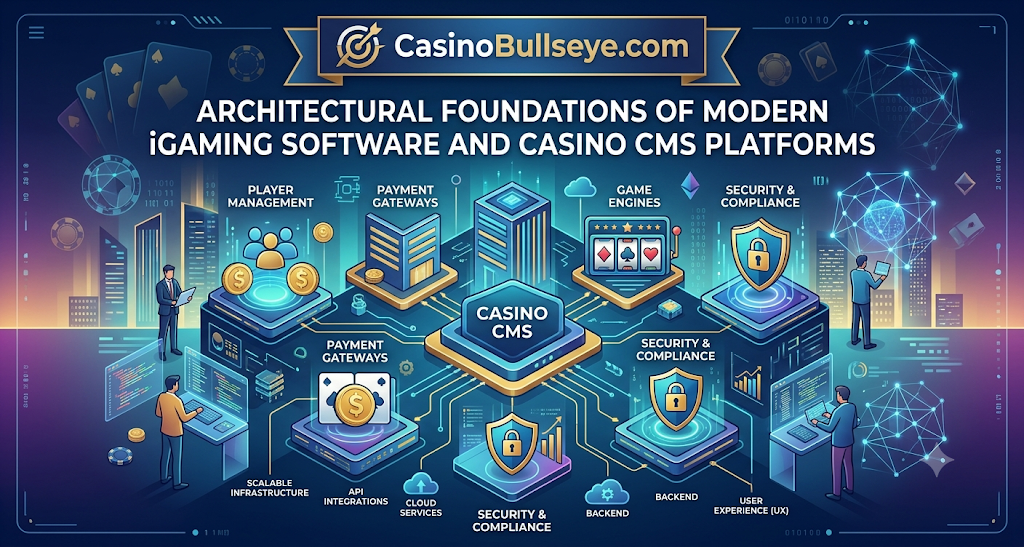
Casino platform software acts as the central nervous system connecting disparate digital technologies. A typical enterprise architecture links the front-end website and CMS directly to gaming content APIs, payment processors, CRM engines, and analytics suites.
| Technology Layer | Primary Function | Typical Integration Method |
| CMS & Publishing | Content creation, SEO, and user engagement | Headless APIs or Monolithic Templates |
| Payment Gateways | Transaction processing and banking security | Secure REST APIs / Webhooks |
| CRM & Marketing | Player segmentation and automated messaging | Event-driven microservices |
| Analytics & BI | Performance tracking and data visualization | Data warehouses / SDKs |
Robust API management ensures that data flows securely and reliably between these components without introducing latency or single points of failure.
Important Features to Evaluate in Casino Software
When researching casino platform software or content systems, technology decision-makers should evaluate solutions against a rigorous framework:
- Scalability: Can the architecture handle traffic spikes and rapid content expansion without performance degradation?
- Integration Flexibility: Does the platform support robust REST APIs, webhooks, and third-party plugins?
- Security Infrastructure: Are role-based access controls, data encryption (at rest and in transit), and secure coding practices enforced?
- SEO Capabilities: Does the system allow custom URL structures, automated schema markup, and fast page rendering speeds?
- Localization Support: Can the software seamlessly manage multi-language deployments and regional content variations?
- Editorial Workflows: Do staging environments, revision histories, and multi-user approval queues streamline publishing operations?
Integrations in iGaming Software
Modern iGaming software rarely exists as a monolithic application. Instead, it relies on a web of microservices and third-party integrations connected via APIs. Common integration categories include payment processors, identity verification (KYC) providers, game aggregators, and CRM tools.
Integration challenges often involve maintaining data consistency during high-traffic events, handling API rate limits, managing vendor dependencies, and ensuring that third-party outages do not compromise core site functionality. Thorough error logging and fallback mechanisms are essential architectural safeguards.
Casino Software Security
Security is paramount in digital publishing and gaming infrastructure. Protecting administrative interfaces, user databases, and API endpoints requires a multi-layered defense strategy:
- Identity and Access Management (IAM): Enforcing mandatory multi-factor authentication (MFA) and strict principle-of-least-privilege access rules.
- Data Protection: Utilizing strong encryption standards (such as TLS 1.3 for data in transit and AES-256 for data at rest).
- Secure API Design: Implementing robust rate limiting, token-based authentication (e.g., OAuth 2.0), and rigorous input sanitization to prevent injection attacks.
- Monitoring and Auditing: Maintaining immutable audit logs to track administrative actions, failed login attempts, and system anomalies.
- Disaster Recovery: Conducting regular automated backups and offsite snapshot storage to ensure rapid restoration in the event of infrastructure failure.
SEO and Content Management for Casino Websites
Search engine optimization in the gaming and publishing sector requires more than basic keyword placement. A specialized casino content management system supports SEO teams by providing fine-grained control over technical elements:
- Structured Data (Schema Markup): Automatically embedding Review, Organization, and Article schema to enhance search engine snippet visibility.
- Performance Optimization: Utilizing edge caching, content delivery networks (CDNs), and optimized asset pipelines to maintain high Core Web Vitals scores.
- Internal Linking Architecture: Streamlining contextual linking between reviews, guides, and category pages to build topical authority.
- Canonical Tag Management: Preventing duplicate content issues across syndicated reviews or multi-region landing pages.
While technical optimization creates a strong foundation, search engine rankings ultimately depend on content quality, user experience, and ongoing search algorithm evaluations.
Choosing the Right Casino CMS or iGaming Software
Selecting the appropriate software solution requires a methodical evaluation of organizational goals, technical capabilities, and long-term scaling requirements. Decision-makers should consider:
- Define Business Requirements: Map out exact content volumes, user traffic projections, and integration needs before reviewing vendors.
- Evaluate Total Cost of Ownership (TCO): Factor in licensing fees, custom development, hosting infrastructure, ongoing maintenance, and support costs.
- Assess Technical Architecture: Determine whether a headless, decoupled, or traditional monolithic CMS best aligns with internal development resources.
- Review Compliance and Security Posture: Ensure the software meets data protection standards and regulatory obligations relevant to target operating regions.
- Test Editorial Usability: Involve content teams in software trials to evaluate day-to-day workflow efficiency and publishing speed.
Casino CMS vs. General-Purpose CMS
| Evaluation Factor | Specialized Casino / iGaming CMS | General-Purpose CMS |
| Structured Content | Native fields for games, bonuses, and ratings | Requires custom post types and plugins |
| Specialized Workflows | Tailored review, compliance, and update queues | Standard linear publishing workflows |
| Gaming Integrations | Pre-built connectors for data feeds and APIs | Requires custom API development |
| Flexibility | Optimized for structured data and high-volume portals | Highly extensible for general blogging and corporate sites |
| Customization | Built for tabular comparisons and dynamic matrices | Relies on community plugins and third-party themes |
| Maintenance | Specialized updates aligned with industry standards | Broad community support with frequent core updates |
| Scalability | Designed for large relational data networks and high traffic | Highly scalable with appropriate caching and enterprise hosting |
Online Casino Technology vs. Land-Based Casino Technology
While both online and land-based gaming sectors share foundational goals—such as secure data handling and operational efficiency—their technological implementations differ significantly:
- Online Environments: Rely on web applications, cloud infrastructure, REST APIs, digital payment gateways, distributed content platforms, and automated CRM pipelines operating across global networks.
- Land-Based Environments: Depend on physical property networks, slot-monitoring systems, physical access control, closed-circuit surveillance, on-premise servers, and cage accounting hardware.
Certain administrative layers—such as high-level analytics, compliance reporting, and player loyalty databases—frequently overlap or integrate across omnichannel operations, bridging the physical and digital divide.
Responsible Gaming and Compliance Considerations
Digital gaming platforms and publishing sites operate within complex regulatory frameworks. Technology stacks must often accommodate jurisdiction-specific requirements, including:
- Integration with identity verification and age-assurance services.
- Support for responsible gaming links, self-exclusion registries, and support resource visibility.
- Adherence to regional data privacy regulations (such as GDPR or CCPA) regarding user consent and data portability.
Disclaimer: This information is for educational and technical research purposes only and does not constitute legal or regulatory advice. Organizations should consult qualified legal professionals to determine compliance obligations in specific jurisdictions.
Common Mistakes When Selecting Casino Software
Organizations embarking on software procurement frequently encounter avoidable pitfalls. Recognizing these mistakes helps technology teams protect their investments:
- Selecting Solely on Price: Choosing the cheapest platform often leads to high technical debt, expensive custom patches, and poor long-term scalability.
- Underestimating Integration Complexity: Failing to audit API documentation and data structures can cause severe delays during deployment.
- Neglecting Editorial UX: Selecting a system that frustrates content teams leads to slow publishing velocity and human error.
- Ignoring Security Standards: Overlooking role-based access controls and encryption protocols exposes platforms to vulnerabilities.
- Failing to Plan for Data Portability: Getting locked into proprietary database structures makes future platform migrations extremely difficult.
How CasinoBullseye.com Helps Technology Researchers
Navigating the vast ecosystem of gaming technology requires reliable, structured research. CasinoBullseye.com serves as a specialized knowledge hub for professionals exploring digital infrastructure.
Whether researching casino CMS solutions, evaluating casino management software, comparing iGaming software platforms, or analyzing casino website software, the platform provides objective insights into modern software architecture, integration patterns, and publishing workflows. By aggregating technical analysis and industry guides, CasinoBullseye.com helps developers, operators, and digital publishers make informed technology decisions.
Frequently Asked Questions
What is a casino CMS?
A casino CMS is a specialized content management system engineered to organize, structure, and publish gaming-specific data such as game metadata, bonus structures, casino reviews, and payment guides.
What is casino management software?
Casino management software refers to backend applications used by gaming businesses to handle operations, customer relationship management, promotional tracking, and reporting analytics.
What is iGaming software?
iGaming software encompasses the broader technology stack required to run online gaming operations, including player account management systems, payment gateways, game aggregators, and security modules.
What is an iGaming CMS?
An iGaming CMS is a content management platform tailored for high-volume gaming websites and affiliate portals, featuring built-in tools for handling complex data relationships, multi-language localization, and SEO structuring.
What is casino website software?
Casino website software comprises the front-end user interface, web hosting infrastructure, content APIs, and publishing tools that deliver the digital experience to end users.
What is casino platform software?
Casino platform software is the core technology layer that connects disparate systems—such as the CMS, payment processors, game providers, and CRM tools—via secure APIs.
What features should casino management systems provide?
Essential features typically include player data management, secure access controls, promotional configuration tools, real-time reporting dashboards, and robust integration capabilities.
How does a casino CMS differ from a general CMS?
A specialized casino CMS includes native data structures, review schemas, and publishing workflows tailored specifically to the gaming industry, whereas a general CMS requires extensive custom plugins to achieve similar functionality.
Why are integrations important in iGaming software?
Integrations allow disparate systems—such as payment gateways, identity verification services, and game aggregators—to communicate seamlessly, ensuring a unified and functional user experience.
What security features should casino software include?
Core security measures include role-based access control, multi-factor authentication, robust data encryption in transit and at rest, secure API design, and comprehensive audit logging.
Conclusion
Selecting and implementing appropriate technology is critical for the success of modern online gaming and publishing businesses. A robust technical foundation—anchored by a scalable casino content management system, secure APIs, and flexible iGaming software—empowers organizations to handle growing content volumes, maintain stringent security standards, and optimize editorial workflows.
As digital ecosystems continue to evolve, staying informed about platform architecture and integration best practices remains essential. Explore the resources on CasinoBullseye.com to deepen your understanding of casino management systems, casino platform software, and modern iGaming technology.
